
An inheritance does not always need to pass directly into a beneficiary’s hands. A testamentary trust will in QLD may suit an estate plan where you want a trustee to manage assets for beneficiaries, particularly in a blended family, where someone may need support managing money, or where income may be distributed to minors. The trust is created by the will and takes effect after the will-maker’s death.
It is understandable to want to provide for loved ones while considering who will control an inheritance and how it can be used. A testamentary trust can set out a framework for those decisions, but it also brings trustee responsibilities and ongoing administration, so it is not automatically right for every estate. This article explains when the structure may help, how it differs from a straightforward gift under a will, and what to consider about beneficiary protection and tax treatment of income distributed to minors.
Key Takeaways
- Consider whether your family circumstances call for more control over how an inheritance is managed, rather than an outright gift.
- Explore how trustee decisions can support a beneficiary who may need help managing money or accessing funds gradually.
- Understand that tax treatment for income distributed to minors depends on the type of trust income and applicable rules.
- Weigh the potential benefits against trustee duties, administration and the limits of what a will controls.
When Should You Use a Testamentary Trust?
A testamentary trust may suit an estate plan where beneficiaries need managed access to an inheritance. In Queensland, it can provide flexibility for family succession and asset protection, but it cannot control every asset or guarantee protection.
Protecting Beneficiaries’ Assets
A testamentary trust holds specified inheritance assets under a trustee’s management instead of transferring them outright. This can matter when a beneficiary faces business failure, insolvency, or difficulty managing money. For example, a will-maker may place an inheritance in trust so a trustee manages the capital and makes distributions under the will’s terms. The structure can help preserve assets for vulnerable beneficiaries while allowing the trustee to respond to changing needs.
Protection from Creditors and Relationship Breakdown
Can a testamentary trust protect inherited assets from creditors or relationship breakdown? It may make assets harder to access, but protection is not automatic or guaranteed. The trust’s terms, trustee decisions, and the beneficiary’s circumstances can all affect the outcome.
For a beneficiary running a business, keeping an inheritance in a trust may reduce its direct exposure to business debts or insolvency risks. A creditor generally cannot access trust funds without a relevant court order. A trust’s effect on how inherited assets are treated during a relationship breakdown can depend on the circumstances. The structure should reflect the beneficiary’s risks rather than assume complete separation.
Assets Inside and Outside the Will
A will can direct specified estate assets into one or more testamentary trusts, so careful asset identification matters. A trust disposition under a testamentary trust can have a perpetuity period of 125 years, unless the trust terms provide for a shorter period, according to Queensland Government. The will’s terms determine which assets enter the trust and how trustees manage them for beneficiaries.
Some assets pass outside the will. In Queensland, property held as joint tenants passes directly to the surviving owner, while superannuation death benefits follow the member’s nominated beneficiary or the fund’s rules. These assets generally cannot be redirected into a testamentary trust simply by naming them in the will. Distinguishing estate assets from these exclusions helps align the succession plan with the inheritance you intend each beneficiary to receive.
Protection for vulnerable beneficiaries
A testamentary trust can give a trustee control over how an inheritance is managed for a beneficiary. A testamentary trust will in Queensland may be useful when a beneficiary needs support with financial decisions, but its terms must suit their circumstances.
Managing Inheritances for Vulnerable Beneficiaries
A testamentary trust lets a trustee manage assets for someone who struggles with budgeting, addiction or financial decisions. Instead of receiving capital outright, the beneficiary may receive distributions for specific needs, such as rent, education or care. For example, a trustee could pay a service provider directly rather than release a large sum. If an inheritance intersects with a family business, business succession advice can help align the arrangements.
Providing for Children and Vulnerable Beneficiaries
A trust can provide for children without giving them immediate control of their inheritance. In Queensland, a child typically gains control of a direct inheritance at 18. Trust terms can instead allow a trustee to fund the child’s welfare or education and release capital at a later age. Similar arrangements may assist an adult beneficiary with disability or money-management difficulties, while tailoring distributions to that person’s circumstances.
Trustee Powers and Beneficiary Distributions
The will sets out the trustee’s powers and the framework for distributing trust income and capital. A discretionary trust gives trustees flexibility to decide which beneficiaries receive distributions and when. Under the Trusts Act 2025 (Qld), trustees must exercise reasonable care, diligence and skill under s 62, and act honestly and in good faith under s 63. Beneficiaries can access trust records under s 65.
Suitability for Estates and Beneficiaries
A testamentary trust will in Queensland may suit an estate plan where a beneficiary needs ongoing support, but it adds trustee responsibilities and administration. Who can be a trustee and beneficiary of a testamentary trust in Queensland? A beneficiary may also be a trustee, and the primary beneficiary is often appointed. However, under s 13 of the Trusts Act 2025 (Qld), a child or a person who is an insolvent under administration cannot be appointed trustee. The will can name beneficiaries individually or define a class, such as family members. Trustees should be selected for their ability to manage assets and make decisions under the will’s terms.
Tax treatment of income distributed to minors
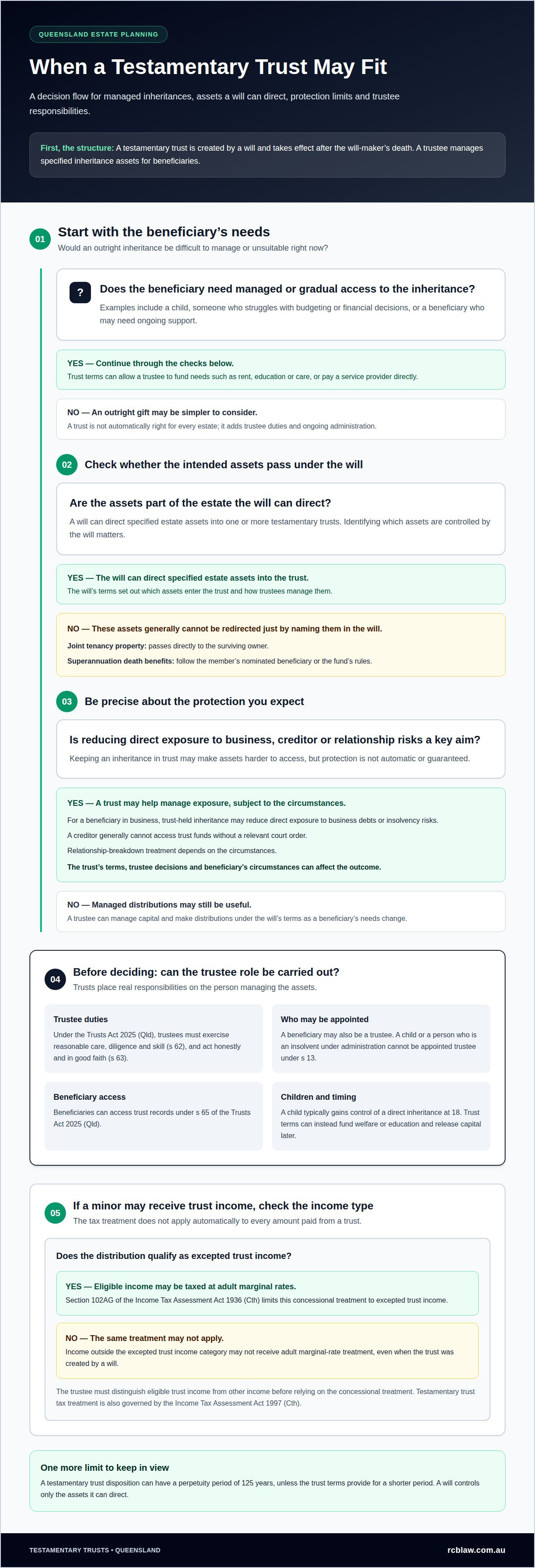
In Australia, income distributed from a testamentary trust to a minor beneficiary is taxed at adult marginal rates, rather than the penalty rates that apply to other trust distributions to children. This treatment can matter when an inheritance earns income, but it does not apply automatically to every amount paid from the trust. The key distinction is whether the income qualifies as excepted trust income.
Section 102AG of the Income Tax Assessment Act 1936 (Cth) limits the concessional treatment to excepted trust income. Income outside that category may not receive the same treatment, even when the will created the trust. For example, a trustee considering a distribution to a child must distinguish eligible trust income from other income before relying on adult marginal rates. The tax treatment of testamentary trusts is also governed by the Income Tax Assessment Act 1997 (Cth).
A discretionary trust may give its trustee flexibility to distribute eligible income among beneficiaries according to the will’s terms and their circumstances. For example, a trustee may allocate income to a child beneficiary rather than distribute all income to an adult beneficiary on a higher income. Distributions to children under 18 may use each child’s tax-free threshold and lower marginal tax tiers. The result depends on the income type, the beneficiary receiving it and the trust’s structure.
Potential tax savings through income splitting should be considered alongside the trust’s ongoing administration. Trustees may need to arrange annual trust tax returns when the trust earns income and keep clear records of decisions and distributions. Distribution decisions should reflect the beneficiary’s needs as well as the tax effect. A testamentary trust can offer tax flexibility, but it does not make every distribution tax-efficient. The trust terms, source of income, and tax rules determine how income is assessed.
What are the benefits and risks of a testamentary trust in Queensland?
A testamentary trust can give trustees flexibility to manage estate assets for different beneficiaries. In Queensland, this structure can support changing needs, but it also creates ongoing administration and cannot remove every estate risk.
For example, a capital-reserved trust can preserve assets for children while providing income to a surviving partner. A life interest or right of residence can allow someone to live in a property before it passes to other beneficiaries. Trustees can also adjust income and capital distributions as beneficiaries’ circumstances change. These options can help balance support for one person with succession plans for others.
There are limits. The Supreme Court of Queensland can requisition assets allocated to a testamentary trust to meet a successful Family Provision Application. A trust therefore cannot guarantee that intended distributions will remain untouched by an eligible claim. Creditors may also pursue claims in relevant circumstances, so asset protection should not be treated as automatic. The strength and effect of a trust depend on its terms and how trustees administer it.
Administration is another practical consideration. Where a trust earns income, trustees may need to arrange an annual trust tax return, maintain records and document decisions. The Trusts Act 2025 (Qld) requires trustees to act honestly and in good faith, and to exercise reasonable care, diligence and skill. A trust also involves more detailed will drafting and higher initial setup costs than a standard will, followed by continuing trustee duties.
Consider whether the added control and tailored distributions address a real need in your estate plan. If they do, discuss testamentary trust planning as part of preparing your will.
RCB Law: Will Drafting
RCB Law can help you set out your estate plan in a clear, carefully drafted will. If you are considering a testamentary trust, will drafting can address how the trust is created, which estate assets it receives, who may benefit, and what powers the trustee needs. These decisions matter particularly when you are balancing support for a vulnerable beneficiary with long-term plans for other family members.
Discuss your family circumstances, intended beneficiaries, and succession priorities so your will reflects the arrangements you want to make. RCB Law also advises on business law, which may be relevant when business interests form part of your estate plan. A testamentary trust needs careful drafting because its terms guide trustee decisions after your death.
For help considering your will, contact RCB Law.
Take the next step with a plan that can evolve
Your estate plan can change as your family circumstances, assets, and priorities shift. A testamentary trust will in QLD is one option to consider when deciding how your will should reflect those changes. Start by identifying what you want your estate plan to achieve, then consider how the will’s terms could support that intention.
Those decisions may connect with other parts of your financial life. RCB Law’s work in residential conveyancing, commercial property law, and business law may be relevant when your estate includes a home, commercial property, or business interests. Considering those assets together can help you approach succession planning with greater clarity.
If you’re ready to discuss how your will could reflect your circumstances, contact RCB Law to discuss your estate plan. A thoughtful conversation can help you take the next step with confidence.
Frequently Asked Questions
Can I alter the trust later?
Yes. While you retain legal capacity, you can change your arrangements by making a new valid will. A testamentary trust’s terms are generally fixed after death unless a court order changes them. An Enduring Power of Attorney holder cannot create or alter the trust for you. If your wishes change, a new will is the relevant document to update.
Can minors benefit from a testamentary trust?
Yes, a will can provide for minors through a testamentary trust. Under sections 128 and 130 of the Trusts Act 2025, a trustee may apply up to the greater of A$100,000 (CPI-adjusted) or half the child’s expected share of trust capital for maintenance, education or advancement. This can support needs such as school expenses or care without transferring the full inheritance directly.
Does a testamentary trust bypass probate?
No. A testamentary trust is created through a will and takes effect after the will-maker’s death. Probate is therefore part of the process before the trust can operate. For example, naming a trustee in the will does not give that person authority to manage trust assets before the trust takes effect.
Is a testamentary trust suitable for all estates?
No. A testamentary trust is not the default choice for every estate. A straightforward estate with adult beneficiaries who can manage outright gifts may not need trust administration. A trust may be more relevant where the will-maker wants ongoing management or controlled distributions. Consider whether those benefits justify tasks such as keeping trust records and arranging tax returns when the trust earns income.
What does a trustee have to do in Queensland?
A trustee must manage trust property under the will’s terms and meet their statutory duties. The Trusts Act 2025 (Qld) requires reasonable care, diligence and skill under s 62, and honesty and good faith under s 63. Practical administration can include keeping a separate bank account for the trust, obtaining a tax file number, recording decisions and arranging annual tax returns where income is earned.
Who should I pick as trustee?
Choose someone able to manage assets carefully, keep clear records and make decisions in the beneficiaries’ interests. A relative may understand the family’s needs, but the role also involves administration and communication. Under s 13 of the Trusts Act 2025 (Qld), a child or a person who is an insolvent under administration cannot be appointed. Consider the person’s judgement and willingness to carry out the role.


