
Matching wills don’t necessarily bind a surviving partner to keep the same plan. In NSW, mutual wills involve an agreement between two parties to make wills on binding terms, including a promise not to revoke or change them except as agreed. The legal requirements for a mutual will agreement therefore go beyond matching gifts: clear evidence of the agreement and its binding effect matters.
It’s understandable to want certainty about where assets will go, particularly in a blended family. But a mutual wills arrangement can also limit the survivor’s choices. Its terms determine how the survivor may use or deal with assets during their lifetime.
This article explains how mutual wills differ from mirror wills, how an agreement may be enforced and how it can set out asset distribution. It also covers practical limits, including the risk that assets may be spent or claims may affect the estate, to help you assess whether this approach fits your circumstances.
Key Takeaways
- Matching wills alone don’t create a binding mutual wills agreement; clear evidence of an intention to be legally bound matters.
- Understand how the agreement affects changes to the wills while both parties are alive and after one party dies.
- Define which assets are covered and what the survivor may do with them to make the intended distribution clearer.
- Weigh the protection for beneficiaries against limits on the survivor and the possibility of claims against the estate.
Mutual Wills NSW: What Is a Mutual Will?
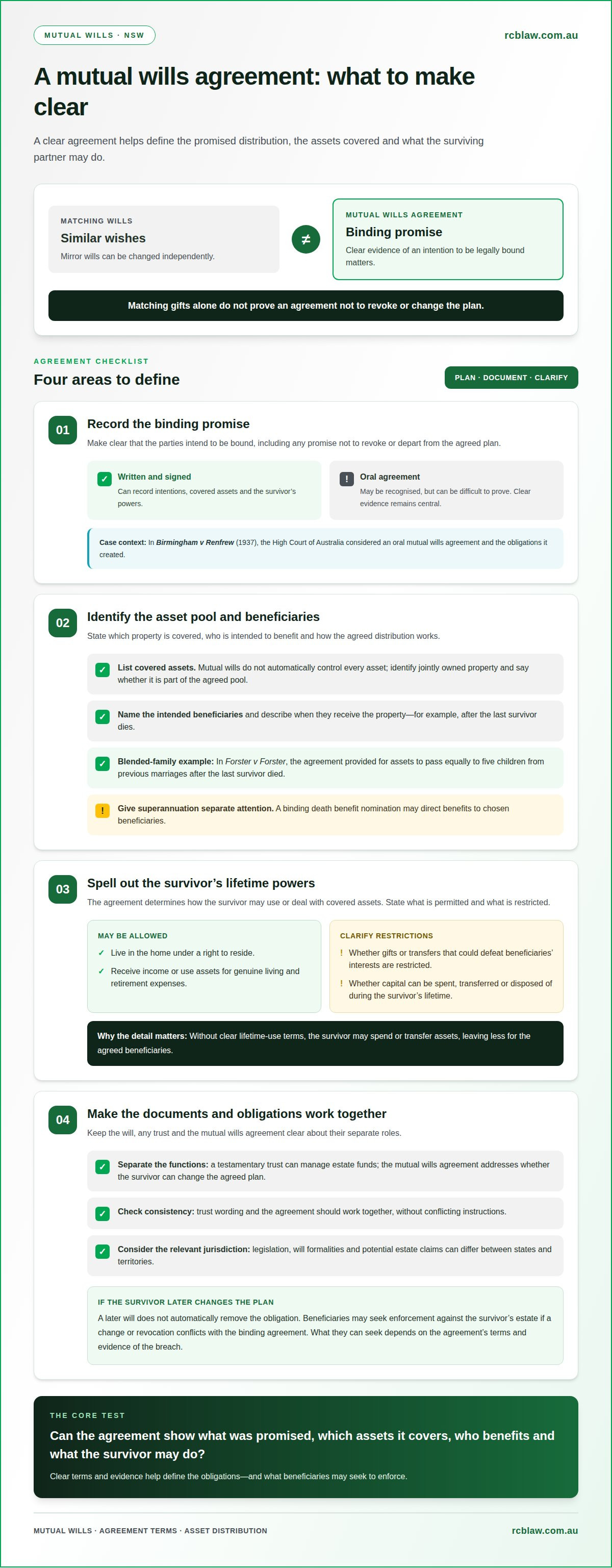
A mutual wills arrangement is a contract between two parties, often a couple, to make wills on agreed, binding terms. Understanding the legal requirements for a mutual will agreement means looking for an intention to be bound, including a promise not to revoke or depart from the plan. Matching or reciprocal wills alone don’t prove that promise. Mirror wills can be changed independently.
While both parties have legal capacity, they can agree to amend or end their arrangement. One person acting alone may breach the contract by changing their will. After one party dies, the survivor may still make a new will, but that doesn’t automatically remove the obligation. If the survivor changes or revokes a mutual will contrary to the agreement, beneficiaries may seek enforcement against the survivor’s estate.
The underlying concept applies across Australia, but legislation and estate rules can differ between states and territories. For clients based in New South Wales or managing cross-border estates, the legal requirements for a mutual will agreement include clear evidence of binding terms, not simply similar wishes. Will formalities and potential claims against an estate also depend on the relevant jurisdiction, and RCB Law can assist in navigating these interstate complexities.
A written, signed agreement can record the parties’ intentions, the assets covered and the survivor’s powers. An oral agreement may also be recognised, but it can be difficult to prove. In Birmingham v Renfrew (1937), the High Court of Australia considered an oral mutual wills agreement and the obligations it created. Clear evidence and an intention to be bound remain central.
Blended families may use mutual wills to provide for a surviving spouse while preserving an inheritance for children from earlier relationships. The agreement should explain whether the survivor can live in a home, receive income or spend capital during their lifetime. For example, a right to reside may let the survivor stay in a home while preserving it for agreed beneficiaries. Without clear terms about lifetime use, the survivor may spend or transfer assets, leaving less for those beneficiaries.
Enforcing a mutual Will agreement
Enforcement depends on evidence that the arrangement was binding, not simply that both wills matched. The agreement’s terms shape what beneficiaries can seek if the survivor changes the plan.
Beneficiaries Enforcing the Agreement
Beneficiaries named in the original mutual wills may bring legal action if the surviving spouse breaks the agreement. This matters in blended families, where children may rely on a promise that an inheritance will pass to them after the survivor’s death. A mutual wills contract doesn’t automatically create a constructive trust for each anticipated beneficiary. The agreement and alleged breach must support the claim.
Enforcement After a Death
After one party dies, the survivor may be bound by the agreed terms, even if they make a later will. In Birmingham v Renfrew (1937), the High Court of Australia recognised an oral mutual wills agreement that created a constructive trust enforceable by intended beneficiaries against the survivor’s executors. That example shows why evidence matters. A signed document can help explain the arrangement, covered assets and promised distribution.
Enforcing the Original Mutual Will
A claim may focus on whether a later will or transfer conflicts with the original agreement. In Thynne v Sheringham [2023] NSWCA 181, the NSW Court of Appeal applied and upheld the decision in Forster v Forster (No 2). In that Queensland case, a written agreement created a continuing obligation for the survivor to deal with inherited property according to its terms. The decision illustrates that an agreement’s wording can be central to enforcement.
Estate planning documents should distinguish the will from any separate promises about future conduct. For example, a testamentary trust may set out how estate funds are managed, while the mutual wills agreement addresses whether the survivor can change the agreed plan. Clear records help beneficiaries understand what was promised and which property the arrangement covers.
Agreed distribution of assets and beneficiaries
A mutual wills agreement should identify the assets covered, the intended beneficiaries and the survivor’s powers. These terms help define the survivor’s obligations and what beneficiaries may seek to enforce.
For blended families, the agreement can set out whether assets pass first to the surviving spouse, then to children from both relationships. It may instead direct property to children immediately, leaving the spouse without an interest in that estate. In Forster v Forster, the couple’s agreement provided for assets to pass equally to five children from previous marriages after the last survivor died.
Lifetime use needs equal care. The terms can allow a surviving spouse to use matrimonial assets for genuine living and retirement expenses, while restricting gifts or transfers intended to defeat beneficiaries’ interests. A right to live in a home or receive income can preserve capital for children. Without clear limits, the survivor may spend or dispose of property, reducing what ultimately passes to beneficiaries.
A testamentary trust can control how estate funds are managed for beneficiaries after death. The agreement should explain how the trust relates to the promised distribution and the survivor’s permitted use. Trust wording and the mutual wills contract serve different functions, so their terms should work together rather than leave conflicting instructions.
Mutual wills affect beneficiaries and trust property covered by the agreement, but they don’t automatically control every asset. The parties should identify jointly owned property and state whether it forms part of the agreed pool. Superannuation also needs separate attention: a binding death benefit nomination may direct benefits to chosen beneficiaries, but the mutual wills arrangement itself doesn’t necessarily determine who receives them.
Clear asset descriptions reduce uncertainty for families and help distinguish the agreement’s scope from other estate planning documents. The trade-off is flexibility: the more firmly the contract protects an agreed inheritance, the less freedom the surviving spouse may have to change the distribution as circumstances evolve.
Risks and limitations of mutual Will agreements
The main trade-off is certainty for beneficiaries versus flexibility for the survivor. After one party dies, the survivor may remain bound by the agreement, limiting changes to their estate plan. Yet the agreement doesn’t necessarily stop the survivor spending, selling or transferring assets during their lifetime. If the asset pool is depleted, children or other beneficiaries may receive less than intended. The terms must explain what the survivor can do.
A mutual wills agreement also doesn’t prevent an eligible person from bringing a family provision claim against a deceased person’s estate. In Barns v Barns (2003), the High Court of Australia held that property subject to mutual wills could be available to meet a family provision order under South Australian law. The case illustrates a limit: an agreement between parties cannot remove every potential claim against an estate.
Changing circumstances can make a binding arrangement difficult for the survivor. Remarriage, a new partner, changed care needs or financial pressure may create competing responsibilities. Mutual wills can restrict the survivor’s ability to provide for a new spouse or adapt distributions for children. A new partner may also make a claim against an estate, and the Family Court may make property orders after a relationship breakdown. These possibilities matter to families planning across states.
Unclear terms create another risk. If the agreement doesn’t identify covered assets, permitted lifetime spending or the intended beneficiaries, later disputes may focus on what the parties promised. Lawyers should address how changes work while both parties have capacity, and what obligations apply after death. Mutual wills suit parties seeking a fixed plan, not those expecting broad freedom to revise it. To discuss how property arrangements affect estate planning, speak with a lawyer.
RCB Law: Will Drafting
RCB Law drafts wills for people considering a mutual wills arrangement or reviewing how their estate plan should work. This can be useful when a couple wants to protect children from previous relationships while providing for a surviving spouse.
Careful drafting can set out the intended beneficiaries, assets covered and limits on the survivor’s use of property. It can also clarify how the wills relate to a separate agreement, reducing uncertainty about each party’s obligations and the intended distribution. Because mutual wills can restrict future changes, the terms should reflect both parties’ wishes and likely circumstances.
If you’re considering mutual wills or need to review your estate planning documents, contact RCB Law to discuss will drafting.
Make your estate plan work for your circumstances
Understanding the legal requirements for a mutual will agreement is a starting point. The next step is deciding whether its binding structure suits your family, assets and future priorities. Consider how your plans may need to respond to changing circumstances, and how property or business interests fit alongside your wishes. A carefully considered estate plan can bring greater clarity to decisions that affect the people closest to you.
RCB Law provides will drafting, alongside residential conveyancing, commercial property law and business law. If property ownership or business interests form part of your planning, those areas may also be relevant to the legal picture. A discussion with RCB Law can help identify the issues that need attention and inform your next steps.
Discuss mutual wills with RCB Law and take a considered next step for your family’s future.
Frequently Asked Questions
What Happens If One Party Changes The Mutual Will Without Consent?
Changing a will without the other party’s consent may breach the mutual wills agreement, even if the new will is legally made. The new document may affect how the estate is administered, while the agreement may still support a claim by intended beneficiaries. For example, a later will leaving assets to different people could prompt a dispute about the original promise and which property it covered.
What is a Mutual Will Agreement?
A mutual will agreement is a contract in which two parties agree to make wills on binding terms. It can set out who receives particular assets and what restrictions apply to later changes. For example, partners might agree that the survivor can live in a home, with the property passing to named beneficiaries later. The agreement is distinct from the wills themselves, even when prepared alongside them.
Does the agreement need to be in writing?
No, an agreement may be oral, but proving its terms can be difficult. A signed document can record the parties’ promises, the assets covered and the intended beneficiaries. For example, written terms can clarify whether a promise applies to a home, savings or both. The wills must still be made as wills, and evidence must establish that the parties intended their agreement to bind them.
How is it different from mirror Wills?
Mirror wills usually contain matching or reciprocal gifts, but that similarity doesn’t itself create a contract. Mutual wills involve an additional agreement that the parties intend to be binding. For example, two wills might each leave everything to the survivor, while a mutual wills agreement also records what happens after the survivor’s death. That extra promise can affect whether the survivor may later change the plan.
Is a mutual Will the same as a mirror Will?
No. A mirror will describes matching terms; a mutual will arrangement adds an agreement to follow binding terms. A couple can make mirror wills without promising to keep them unchanged. If one person later revises their will, matching wording in the original documents alone may not establish a breach. The key distinction is the parties’ agreement and intention, not simply identical beneficiary names.
What happens if the survivor breaks the agreement?
Beneficiaries named under the original arrangement may bring a claim if the survivor acts contrary to its terms. The outcome depends on what the parties promised, which assets were covered and what happened to them. For example, a transfer to someone outside the agreed plan may raise different issues from ordinary spending on living costs. Keeping the agreement with estate records can help executors identify the relevant terms.


