
Imagine finding the perfect family home in Brisbane or a quiet retreat on the Sunshine Coast, only to discover that a single missed deadline could result in a six-figure financial penalty. For many foreign investors, the path to securing FIRB approval for residential property qld feels like walking through a legal minefield where federal regulations and state taxes often seem to pull in opposite directions. It's completely natural to feel overwhelmed by the technical jargon and the fear that an application rejection might stall your property dreams.
We understand that this transition is a significant milestone in your life, and you deserve a process that's free from unnecessary friction. This 2026 guide is designed to replace that anxiety with professional clarity by providing a dependable roadmap for your acquisition. You'll learn exactly how to manage federal investment laws alongside Queensland's specific surcharges, ensuring your settlement remains smooth and predictable. We'll provide a structured breakdown of current application fees, Additional Foreign Acquirer Duty (AFAD) requirements, and the essential steps to secure a successful outcome for your new Queensland investment.
Key Takeaways
- Understand how the National Interest test influences your eligibility and why securing FIRB approval for residential property qld is a mandatory step before finalizing your purchase.
- Learn the critical differences between buying new dwellings and established homes to ensure your investment aligns with federal construction goals.
- Gain a clear breakdown of the application timelines and the latest 2026 fee structures to help you budget accurately for your property transition.
- Identify how Queensland's Additional Foreign Acquirer Duty (AFAD) impacts your total acquisition cost so there are no financial surprises at settlement.
- Discover how professional contract reviews and specific FIRB protection clauses can safeguard your deposit and provide a stress-free path to ownership.
What is FIRB Approval and Why is it Essential in QLD?
Buying property in Queensland is an exciting step, but it often comes with a layer of regulatory complexity that can feel daunting. If you aren't an Australian citizen, you likely need a specific green light from the government before you sign a contract. The Foreign Investment Review Board (FIRB) is the primary body responsible for assessing whether your purchase aligns with the country's economic goals.
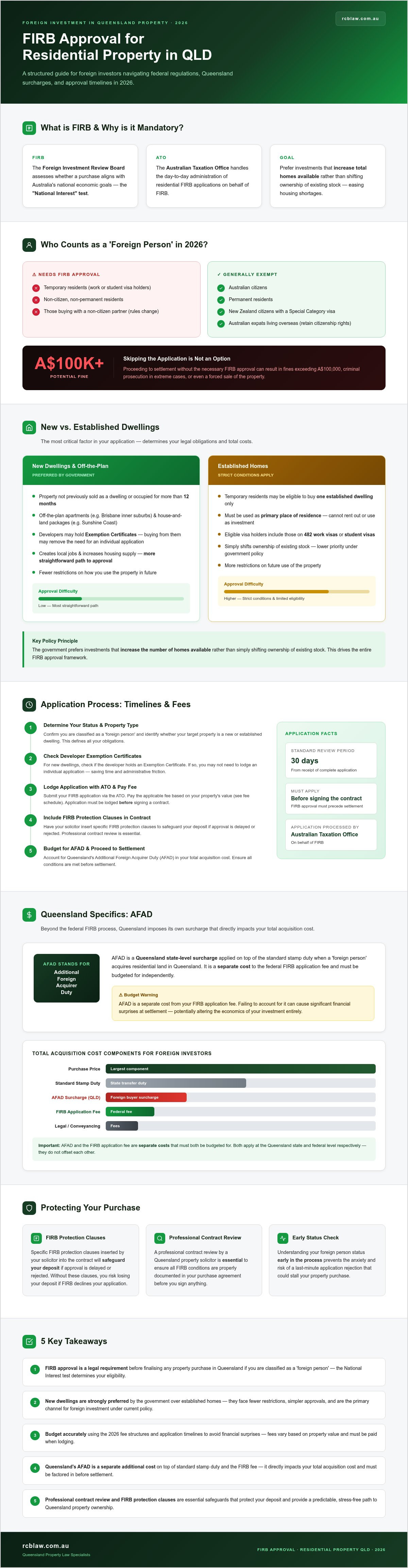
Obtaining FIRB approval for residential property qld isn't just a box-ticking exercise; it's a legal requirement designed to ensure that foreign investment actually benefits the community. In the 2026 market, the Australian government applies a "National Interest" test. This means they prefer investments that increase the total number of homes available, rather than just shifting ownership of existing stock. Failing to secure this approval before you settle on a contract can lead to severe financial penalties or even a forced sale of the property.
The Role of the Foreign Investment Review Board
The Foreign Investment Review Board functions as the gatekeeper for foreign property ownership in Australia. While FIRB provides the policy advice, the Australian Taxation Office (ATO) handles the day-to-day administration of residential applications. Their shared goal is simple: they want to encourage the construction of new dwellings to ease housing shortages. By directing foreign capital toward new builds, the government aims to keep the market accessible for everyone. This focus on supply is why your application's success often depends on what type of property you intend to buy.
Who Counts as a 'Foreign Person' in 2026?
You might be surprised by who the law considers a foreign person. It isn't just about where you were born; it's about your current visa status. Generally, if you aren't an Australian citizen, a New Zealand citizen with a Special Category visa, or a permanent resident, you'll need to apply. Temporary residents, such as those on work or student visas, are still classed as foreign persons for property purposes. Australian expats living overseas usually don't need approval, as they retain their citizenship rights. However, if you're buying with a partner who isn't a citizen, the rules can change quickly. Understanding your status early prevents the anxiety of a last-minute application rejection.
Skipping the application isn't an option. If you proceed to settlement without the necessary paperwork, you risk fines that can exceed A$100,000 or even criminal prosecution in extreme cases. We've seen how these penalties can turn a dream investment into a heavy financial burden. Getting it right from the start is the only way to ensure a stress-free transition into the Queensland property market.
Residential Property Rules: New vs. Established Dwellings
The distinction between new and established property is the most critical factor in your application. Australia's investment policy is built on a specific goal: increasing the number of homes available for everyone. Because of this, the rules are significantly more relaxed if you're adding to the housing stock rather than simply purchasing what's already there. Understanding which category your chosen property falls into will define your legal obligations and your total costs.
Investing in New Dwellings and Off-the-Plan
A 'new' dwelling is typically a property built on residential land that hasn't been previously sold as a dwelling or occupied for more than 12 months. Off-the-plan apartments in Brisbane's inner suburbs or new house-and-land packages on the Sunshine Coast are prime examples. Many large-scale developers in these regions hold Exemption Certificates. If you buy from a developer with one of these certificates, you might not need to lodge an individual application for FIRB approval for residential property qld. This can save you time and significantly reduce the administrative friction during your purchase journey.
New dwellings are the priority for the government. By funneling foreign capital into the construction sector, the policy aims to create local jobs and increase the housing supply. For you, this often means a more straightforward path to approval and fewer restrictions on how you use the property in the future.
Buying Established Homes as a Temporary Resident
If you're a temporary resident, such as someone on a 482 work visa or a student visa, you may be eligible to buy one established dwelling. However, strict conditions apply. You must use the property as your primary place of residence. You cannot rent it out or use it as a holiday home. Most importantly, you're generally required to sell the property within six months of it ceasing to be your home or when your visa expires. Non-resident foreign investors are almost entirely prohibited from buying established houses unless they intend to redevelop the site into multiple new dwellings.
For those looking at vacant land, the requirements are equally specific. You must typically complete construction within four years of the approval date. This ensures the land doesn't sit idle while the market needs more housing. Navigating these categories requires careful attention to the fine print in your purchase contract. Our team at RCB Law can provide a professional residential conveyancing review to ensure your chosen property aligns perfectly with current FIRB regulations, giving you the confidence to move forward with your settlement.
The FIRB Application Process: Timelines and Costs
Securing your property in Queensland requires a clear understanding of the administrative steps involved. The process is structured to be transparent, but it demands precision to avoid delays that could jeopardize your settlement. By following a methodical roadmap, you can move from the initial application to the final approval with confidence and legal clarity.
The journey begins with gathering your essential documents, including your passport, current visa details, and the specific property information such as the title reference and address. Once your paperwork is in order, you'll lodge the application through the Foreign Investment Portal. It's a digital process, but the details must be exact to ensure the ATO can process your request without asking for additional clarification.
After lodgment, the statutory 30-day decision period begins, though this only starts once the application fee is paid in full. During this time, the government reviews your application against the national interest criteria. If your case is straightforward, you'll receive a 'No Objection Notification.' This document is the formal approval you need to finalize your purchase. In some complex cases, the authorities may request an extension of up to 90 days, so early application is always the safest strategy for a stress-free experience.
Budgeting for Application Fees in 2026
Application fees are a significant part of the total cost of acquisition. These fees are tiered, meaning the amount you pay depends directly on the purchase price of the property. It's vital to have these funds ready to go, as the 30-day review clock won't start until the payment is cleared. Regarding refunds, the policy is generally quite strict. Fees are typically non-refundable if your application is rejected or if you decide not to proceed with the purchase. However, if the property sale falls through before a decision is reached, you might be eligible to apply for a fee waiver for a subsequent property purchase, provided the circumstances meet specific ATO guidelines.
Aligning FIRB with Your QLD Property Contract
One of the biggest risks for buyers is the timing clash between a standard Queensland contract and the federal approval process. Most residential contracts in Brisbane or the Sunshine Coast aim for a 30-day settlement, which is exactly the same length as the standard review period for FIRB approval for residential property qld. This leaves no room for error. If you sign an unconditional contract and your approval is delayed, you could be in default, risking your deposit and potential legal damages.
To remove this friction, your contract must include a specific "subject to FIRB" clause. This protection ensures that if your application is denied or delayed beyond the settlement date, you can withdraw from the contract safely. Our team specializes in residential conveyancing and can help ensure these clauses are drafted correctly, protecting your interests while you wait for the government's response.
Queensland Specifics: AFAD and Local Surcharges
While federal approval is your first hurdle, Queensland introduces its own set of financial requirements that every foreign buyer must anticipate. The most significant of these is the Additional Foreign Acquirer Duty (AFAD). This is a state-based tax applied to "foreign acquirers" of residential land in Queensland. It's important to realize that receiving your federal no-objection letter doesn't mean your tax obligations are settled. The state government views these as two distinct processes, and both require your full attention to ensure a legal settlement.
Securing FIRB approval for residential property qld gives you the right to purchase the land, but AFAD defines how much extra you'll pay for that privilege. This surcharge is triggered based on your residency status at the time of the transaction. Because these laws are subject to change, staying informed about the current thresholds is essential for accurate budgeting. We often find that clients feel a sense of relief once the federal paperwork is done, only to feel a new wave of anxiety when state taxes come into play. Our goal is to provide that missing clarity early in the journey.
Calculating the Real Cost of Acquisition
When you buy a home in Brisbane or the Sunshine Coast, you'll pay the standard transfer duty that applies to all residents. However, as a foreign person, you'll also face the AFAD surcharge, which is calculated as a percentage of the property's taxable value. AFAD is a state-based tax, entirely separate from federal FIRB fees. This means your total tax bill can be substantially higher than that of a local buyer. You should also consider ongoing costs, such as Land Tax in Queensland, which can also carry surcharges for foreign owners depending on the total value of your holdings.
Local Conveyancing for Foreign Buyers
Managing these dual layers of regulation requires more than just a general understanding of the law. A local QLD solicitor is vital for navigating conveyancing because they understand the specific timing requirements of the Queensland Revenue Office. From ensuring your AFAD declarations are filed correctly to managing the digital settlement through PEXA, professional oversight removes the friction that often leads to costly settlement delays. This is especially true for foreign residents who may not be physically present in Australia to sign physical documents.
If your investment involves business premises or mixed-use land, you might also need to look into Commercial Conveyancing to ensure all state-based surcharges are accounted for. Certain visa types or specific partnership structures may qualify for concessions, but these are highly technical and require a tailored approach. To ensure you have a complete picture of your financial obligations and avoid any late-payment penalties, you can request a detailed surcharge assessment from our local property experts.
How RCB Law Simplifies Your Foreign Investment Journey
We recognize that buying a home across borders is more than just a financial transaction; it's a major life event that often comes with high pressure. At RCB Law, we've spent over 30 years refining our approach to residential conveyancing, positioning ourselves as a steady guide through these complex transitions. Our goal is to replace your uncertainty with a sense of calm and confidence, ensuring that every legal detail is managed with professional precision.
One of the most critical steps we take is the expert review of your property contract before you commit. We ensure that specific protection clauses are included, making the purchase subject to you receiving FIRB approval for residential property qld. This simple but vital step protects your deposit and gives you the legal room to breathe while the federal authorities process your application. We don't just look at the paperwork; we look out for your future.
Financial surprises are often the biggest source of anxiety for foreign investors. To remove this friction, we provide a clear breakdown of your total tax liability well before settlement. By calculating your standard transfer duty alongside the Additional Foreign Acquirer Duty (AFAD), we help you understand the true cost of acquisition. We also act as the central hub for your purchase, liaising directly with your mortgage broker and the ATO to ensure the "clock" on your application stays on track for a smooth, on-time settlement.
Tailored Advice for Brisbane and the Sunshine Coast
Our deep regional focus means we understand the specific market pressures in Brisbane and the Sunshine Coast. We aren't a distant, transactional entity; we're a supportive partner dedicated to your success in the local Queensland market. By handling the heavy lifting of complex legal paperwork and surcharge declarations, we remove the emotional burden from your shoulders. This allows you to focus on the excitement of your new property while we manage the technicalities of state and federal compliance.
Ready to Secure Your Queensland Property?
The best way to ensure a stress-free experience is to seek legal advice before you sign any documents. A pre-contract review can save you from costly mistakes and provide the clarity you need to move forward safely. We offer a structured, transparent approach to our services, including fixed-fee conveyancing quotes so you can budget with total certainty. When you're ready to take the next step in your Queensland property journey, our team is here to provide the expert assistance you deserve.
Contact RCB Law for expert FIRB and conveyancing assistance
Step Into Your New Queensland Home With Confidence
Securing your future in the Sunshine State shouldn't be defined by regulatory stress. By understanding the nuances of the "National Interest" test and preparing for state-based surcharges like AFAD, you've already taken the first step toward a successful acquisition. Remember that timing is everything; aligning your 30-day decision window with your contract dates is the most effective way to protect your deposit and your peace of mind.
Success in this market relies on more than just paperwork. It's about having a steady guide who understands the local landscape in Brisbane and the Sunshine Coast. With over 30 years of property law experience, we specialize in removing the friction from your property transition. We ensure that every aspect of your FIRB approval for residential property qld is handled with the care and mastery it requires, allowing you to focus on the excitement of your new investment.
Don't let legal complexity stall your property dreams. Secure your QLD property with expert legal guidance from RCB Law and experience a reassuring, stress-free conveyancing process. Your new chapter in Queensland is waiting, and we're here to help you start it on the strongest possible foundation.
Frequently Asked Questions
Can I buy a house in Queensland if I am on a temporary work visa?
Yes, temporary work visa holders can generally purchase one established dwelling in Queensland to use as their primary residence. You cannot use it as an investment property or a holiday home while you hold this visa status. Additionally, you're usually required to sell the property within six months of moving out or when your visa expires. It's essential to secure your FIRB approval for residential property qld before signing an unconditional contract to avoid legal complications.
How much is the FIRB application fee for a A$1 million property in 2026?
Fees for 2026 are tiered based on the property's purchase price and are subject to annual indexation by the federal government. For a property valued at A$1 million, the application fee represents a significant upfront cost that must be paid before the review period begins. Because these costs change every July, we recommend checking the current fee schedule or speaking with our team to ensure your budget accounts for the exact amount required for your specific acquisition.
What happens if I buy a property in QLD without FIRB approval?
Purchasing property without the required approval can lead to severe legal and financial consequences. The Australian government can issue infringement notices with fines often exceeding A$100,000; in serious cases, criminal prosecution may follow. You may also be forced to sell the property at a loss under a disposal order. We prioritize protecting our clients by ensuring all necessary approvals are in place well before the settlement date, providing a much-needed layer of security for your investment.
Does a New Zealand citizen need FIRB approval to buy in Brisbane?
Most New Zealand citizens holding a Special Category visa (subclass 444) are exempt from needing FIRB approval to buy residential property in Brisbane. This exemption applies as long as you are physically present in Australia at the time you sign the contract. However, if you are purchasing through a company or trust, or if you aren't currently in the country, different rules may apply. It's always best to verify your specific situation with a local solicitor to ensure total compliance.
Can I rent out my property if I bought it with FIRB approval?
Your ability to rent out the property depends on the type of dwelling and your residency status. If you purchased a new dwelling or off-the-plan apartment, you're generally free to rent it out as an investment. However, temporary residents who purchase an established home are strictly prohibited from renting any part of it. The property must remain your primary place of residence until you sell it or your residency status changes to a permanent resident or citizen.
How long does it take to get FIRB approval for a residential house?
The standard statutory period for a decision is 30 days from the date the application fee is paid in full. The government then has an additional 10 days to notify you of the outcome. While most applications for FIRB approval for residential property qld are processed within this 40-day window, complex cases can see extensions of up to 90 days. We suggest starting the process as early as possible to align with standard Queensland settlement periods.
Do I have to pay extra stamp duty in QLD as a foreign buyer?
Yes, foreign buyers in Queensland must pay the Additional Foreign Acquirer Duty (AFAD) on top of standard transfer duty. This surcharge applies specifically to residential land and is calculated as a percentage of the property's taxable value. This state-based tax is entirely separate from federal FIRB fees and can significantly increase your total acquisition costs. Our local expertise ensures you have a clear, upfront calculation of these surcharges to avoid any financial surprises at settlement.
What is the difference between FIRB approval and an ATO clearance certificate?
These two documents serve completely different purposes. FIRB approval is the federal permission a foreign person needs to purchase Australian property. An ATO clearance certificate relates to Capital Gains Tax (CGT) withholding and is typically required by a seller to prove they aren't a foreign resident for tax purposes. While both involve the ATO, one is about the right to buy, while the other is about tax obligations during a sale. Understanding these differences is vital for a smooth settlement.


