
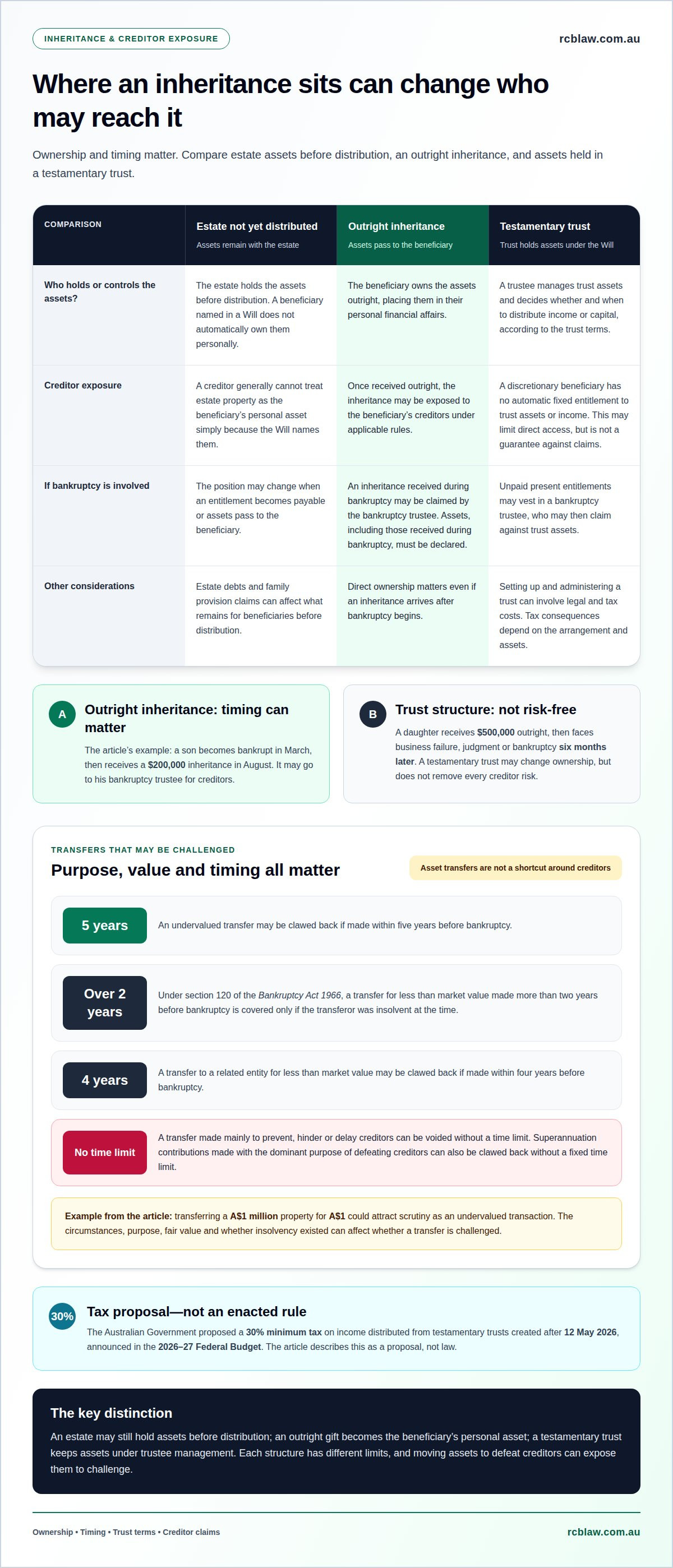
An inheritance can become exposed to creditors once it passes outright to a beneficiary. In Australia, an inheritance received during bankruptcy may be claimed by the bankruptcy trustee. So how to protect an inheritance from creditors in Australia depends largely on who owns or controls the assets. A Will can instead direct assets into a discretionary testamentary trust, which may limit a beneficiary’s direct access to them.
It’s understandable to expect an inheritance to provide lasting security, especially when it’s intended to support a child or another loved one. But the structure of an estate can affect what happens if a beneficiary faces bankruptcy or financial difficulty.
This article explains how outright gifts, trusts and estate property can affect creditor exposure, and why timing and ownership matter. It also covers the limits of trust arrangements, helping you understand options to consider when planning a Will.
Key Takeaways
- An outright inheritance can become exposed to a beneficiary’s creditors; a testamentary trust may offer a different way to hold and manage estate assets.
- Transfers intended to put assets beyond creditors can be challenged, so the purpose and timing of an arrangement matter.
- Who legally owns an inherited asset, and how it is held with others, can affect its exposure to bankruptcy claims.
- Bankruptcy rules treat property, bank balances, vehicles and household belongings differently, making the type and value of each asset relevant.
How Do You Protect Estate Assets From a Beneficiary's Creditors?
A Will can direct an inheritance into a testamentary trust instead of giving assets to a beneficiary outright. The trust’s terms, ownership and distributions shape how creditors may be able to reach the inheritance.
Holding Inheritances in Testamentary Trusts
A testamentary trust is created under a Will to hold estate assets for beneficiaries after the Will-maker dies. A trustee manages those assets and decides whether and when to distribute income or capital, according to the trust terms. This structure may help protect an inheritance from a beneficiary’s creditors because the beneficiary may not own the trust assets outright.
That distinction matters during insolvency: a discretionary beneficiary has no automatic fixed entitlement to trust assets or income. A trust is not a guarantee against claims, however. Unpaid present entitlements may vest in a bankruptcy trustee, who may then claim against trust assets.
Tax also belongs in the estate plan. The Australian Government proposed a 30% minimum tax on income distributed from testamentary trusts created after 12 May 2026, announced in the 2026-27 Federal Budget. It is a proposal, not an enacted rule.
Creditor Access Before Distribution
Before distribution, the estate still holds the assets rather than the beneficiary owning them outright. A creditor generally cannot treat estate property as the beneficiary’s personal asset simply because the Will names them. The position may change when an entitlement becomes payable or assets pass to the beneficiary.
Estate debts and family provision claims can affect what remains for beneficiaries before distribution. For example, an executor may need to resolve estate liabilities or a claim against the estate before distributing the residue. These are separate from a beneficiary’s personal creditors claiming an inheritance already received.
Bankruptcy and Inherited Assets
An inheritance received during bankruptcy may be claimed by the bankruptcy trustee as an asset. A person applying for bankruptcy must declare their assets, including assets received during bankruptcy, to their trustee. Direct ownership therefore matters, even if the inheritance arrives after bankruptcy begins.
For example, a $200,000 inheritance distributed in August to a son who became bankrupt in March may go to his bankruptcy trustee for creditors. A separate example is a daughter receiving $500,000 outright, then facing business failure, judgment or bankruptcy six months later. A testamentary trust may change the ownership structure, but it doesn’t remove every creditor risk.
Trust Costs and Pre-Distribution Steps
Setting up and administering a trust can involve legal and tax costs; the amount depends on the Will’s complexity, the assets and ongoing trust requirements. Gifting assets to a trust or buying assets through one can also have tax consequences, so consider these effects before transferring capital.
Before accepting or distributing an inheritance while dealing with debts, identify whether the Will gives assets directly or through a trust. Establish whether bankruptcy has begun, disclose relevant assets to the bankruptcy trustee, and avoid moving assets to defeat creditors. Centrelink treatment can depend on control and distributions, so don’t assume inherited money or trust assets are invisible to an assessment.
Avoiding transactions intended to defeat creditors
Asset protection should be planned for legitimate reasons, not used to defeat existing claims. Under Australian bankruptcy law, an undervalued transfer may be clawed back if made within five years before bankruptcy. A transfer made mainly to prevent, hinder or delay creditors can be voided without a time limit. Moving assets after financial trouble begins can leave them exposed rather than protected.
Section 120 of the Bankruptcy Act 1966 addresses transfers for less than market value. According to the Federal Register of Legislation, a transfer made more than two years before bankruptcy is covered only if the transferor was insolvent at the time. A transfer to a related entity for less than market value may be clawed back if made within four years before bankruptcy. For example, transferring a A$1 million property for A$1 could attract scrutiny as an undervalued transaction.
Related-party transfers and other antecedent transactions need careful attention because timing, value and the parties’ relationship can affect whether creditors challenge them. A transaction’s label does not settle the issue. The circumstances and purpose matter, including whether the person received fair value and whether insolvency existed when the transfer occurred. The Corporations Act 2001 also contains clawback provisions for certain transfers.
Superannuation contributions are not automatically beyond scrutiny. Under sections 128B and 128C of the Bankruptcy Act 1966, contributions made with the dominant purpose of defeating creditors can be clawed back without a fixed time limit. A testamentary trust established through a Will is different from a last-minute transfer of personal assets, but it still needs sound legal and tax planning. For a considered estate plan addressing creditor concerns, the Will’s terms and the beneficiary’s circumstances should shape the arrangement.
Personal ownership and creditor exposure
Ownership determines whether inherited wealth forms part of a beneficiary’s personal financial affairs. Understanding who owns each asset and how it is held is central to how to protect an inheritance from creditors in Australia.
Personal Ownership of Inherited Assets
Personal ownership means the beneficiary holds an inherited asset in their own name, rather than as a trust beneficiary. Once an inheritance passes outright, creditors may pursue it under applicable rules. For example, inherited capital placed in a personal bank account becomes part of the beneficiary’s financial circumstances, rather than property still held by the estate.
Joint ownership also needs careful consideration. A bankruptcy trustee may claim the bankrupt person’s share of a jointly owned asset, such as half the balance in a joint bank account. If both owners enter bankruptcy, the trustee may have an interest in the full jointly owned asset. A partner’s assets may also be affected if the bankrupt person owns or helped purchase them.
Superannuation is treated differently from ordinary personal assets. Australian bankruptcy law generally protects assets held in a regulated superannuation fund from creditors in bankruptcy. That protection applies to fund assets, not automatically to money withdrawn and held personally.
Creditor Seizure After Distribution
Yes. After an outright distribution, inherited money or assets may be exposed to the beneficiary’s creditors. During bankruptcy, an inheritance received by the bankrupt person may be claimed by the bankruptcy trustee and used towards creditor claims.
Ownership can matter even when another person’s name appears on an asset. A partner’s asset may be affected if the bankrupt beneficiary contributed to its purchase or helped acquire it. The circumstances of the purchase and who provided the funds can therefore matter alongside registered ownership.
For families considering how to protect an inheritance from creditors in Australia, a Will can separate a beneficiary’s right to use property from legal ownership. For example, it may grant a right to occupy estate property without transferring the title. This may offer more creditor protection than giving the beneficiary full ownership, while the estate plan sets out who holds the asset and how it is used.
Vehicles, property, bank balances and household belongings
In bankruptcy, a trustee considers the type of asset, its ownership and its value. Australian rules treat a home, vehicle, bank balance and household contents differently, so the circumstances behind ownership matter.
A trustee can claim a bankrupt person’s house or other property as an asset. Some primary residences may already have protection under Australian law. If a house is purchased entirely with protected money, the trustee may be unable to claim it. If protected money funds 20% of a purchase, the trustee may seek to claim the remaining 80%. Those examples show why the source of funds and legal ownership matter in estate planning.
Bank accounts are assessed according to ownership and balance. If an account is in joint names, a trustee may claim the bankrupt person’s share, such as half the balance. Cash or money in an account at bankruptcy may also be claimed, while enough is left for modest living expenses. Discretionary trust assets have a different ownership structure, but an outright inheritance deposited into a personal account is no longer held by the estate.
For vehicles, the relevant limit determines whether a bankrupt person may keep a vehicle used mainly for transport. A vehicle above that limit may be claimed by the trustee. The same distinction applies to tools used to earn a living: tools below the applicable limit may be kept, while higher-value tools may be sold. Most ordinary household items of reasonable value, including furniture and appliances, can be kept.
These strategies depend on genuine ownership, asset value and how funds were used, not just names on documents. Litigation may also examine whether a partner contributed towards an asset held in their name. For inherited property transactions, seek advice on commercial property law to understand ownership and transfer issues before taking action.
RCB Law
RCB Law can help you consider how your estate plan may affect a beneficiary’s inheritance and creditor exposure. If you’re preparing or updating a Will, tailored Will Drafting can clarify how assets are to pass and whether a testamentary trust may suit your intentions. Where inherited property or business interests are involved, ownership and transfer arrangements can also form part of the planning discussion.
It may be useful to seek legal advice before distributing estate assets, particularly when a beneficiary has debts, faces insolvency or is already bankrupt. The timing and structure of a gift can affect what happens next, so a clear plan can help you make informed decisions about your Will and estate.
Contact RCB Law to discuss your circumstances and the estate planning options relevant to you.
Plan your next step with confidence
Thinking about how to protect an inheritance from creditors in Australia can prompt you to look beyond the Will itself. Consider how future property decisions, business interests and estate intentions fit together, so the arrangements reflect the people and assets involved. Clear advice can help you decide what to document now and what to revisit as circumstances change.
RCB Law can assist with Will Drafting and related legal matters, including Residential Conveyancing, Commercial Property Law and Business Law. These areas may be relevant when an estate plan involves a home, investment property or business interests. The right next step depends on the decisions you need to make and how those assets are held.
Contact RCB Law to discuss your options and take a considered step towards an estate plan that reflects your intentions.
Frequently Asked Questions
Can a bankruptcy trustee claw back assets I transferred into a trust?
Yes, some transfers into a trust can be challenged and clawed back. An undervalued transaction may be reviewed if it occurred within five years before bankruptcy, while a transfer mainly intended to hinder creditors may be voided without a time limit. The timing, value, solvency and purpose of the transfer all matter. A trust does not make a transaction immune from scrutiny.
What is a discretionary testamentary trust?
A discretionary testamentary trust is established under a Will to hold assets for beneficiaries, with a trustee deciding distributions under the trust terms. A beneficiary doesn’t automatically own a fixed share of trust assets or income. For instance, the trustee may retain capital and distribute income when the trust allows. The Will can set out who may benefit and guide how the trustee manages the assets.
Can you use a company or other entity?
A company or another entity may form part of an ownership structure, but its existence alone doesn’t establish creditor protection. The person’s interests in the entity, control over assets and circumstances of any transfer can all matter. Moving assets for less than market value, particularly to a related entity, may attract a clawback claim. Consider the legal and tax effects of a structure before transferring property or capital.
How does it actually work?
With a testamentary trust, the Will directs estate assets into the trust, and a trustee administers them for eligible beneficiaries. The trust terms determine how distributions are considered and made. For example, a trustee may retain an asset rather than transfer it outright to one beneficiary. This can separate legal ownership from a beneficiary’s access, but unpaid present entitlements may still create creditor issues.
Protect it, or leave it to chance?
Make this decision part of estate planning rather than relying on an informal promise about how an inheritance will be used. Consider whether a beneficiary’s financial circumstances call for a trust, staged distributions or a right to occupy property. Each approach affects control and administration differently. A Will should clearly express the intended arrangement, including who manages assets and how beneficiaries may benefit.
How does bankruptcy affect an inheritance in Australia?
Bankruptcy can bring an inheritance received during the bankruptcy into the assets considered by the trustee. The beneficiary must disclose assets received during bankruptcy to that trustee. The result can differ where a Will holds the inheritance in a discretionary trust, because the beneficiary doesn’t automatically own its assets. However, trust entitlements and transfers made to defeat creditors can still give rise to claims.


