
A caveat on a Brisbane property can be removed if the caveator withdraws it, the court orders its removal, or the Registrar cancels it in qualifying circumstances. If you’re working out how to remove a caveat on a property in Brisbane, the key is to identify whether the claimed interest is valid and which removal route fits. Under section 127 of the Land Title Act 1994 (Qld), a property owner can apply to the Supreme Court of Queensland for an order removing a caveat.
A caveat can delay property dealings, so it’s understandable to want a clear path forward. If the caveator won’t withdraw it or the claimed interest appears unsupported, a legal challenge may be appropriate.
This guide explains what makes an interest caveatable in Queensland, how withdrawal, lapse and cancellation work, and what a court considers when deciding whether a caveat should remain. It also sets out practical steps to take before challenging one, so you can understand your options.
Key Takeaways
- Start by identifying whether the caveator will withdraw the caveat or whether a lapse or cancellation process may apply.
- A caveat needs a genuine legal or equitable interest in the property; a debt alone does not create one.
- According to the Queensland Government, a caveatee can give the caveator notice requiring court proceedings to be commenced within 14 days, or the caveat may lapse.
- If the caveat is disputed, understand the court process and the evidence needed before deciding on your next step.
How To Remove a Caveat Over Your Property?
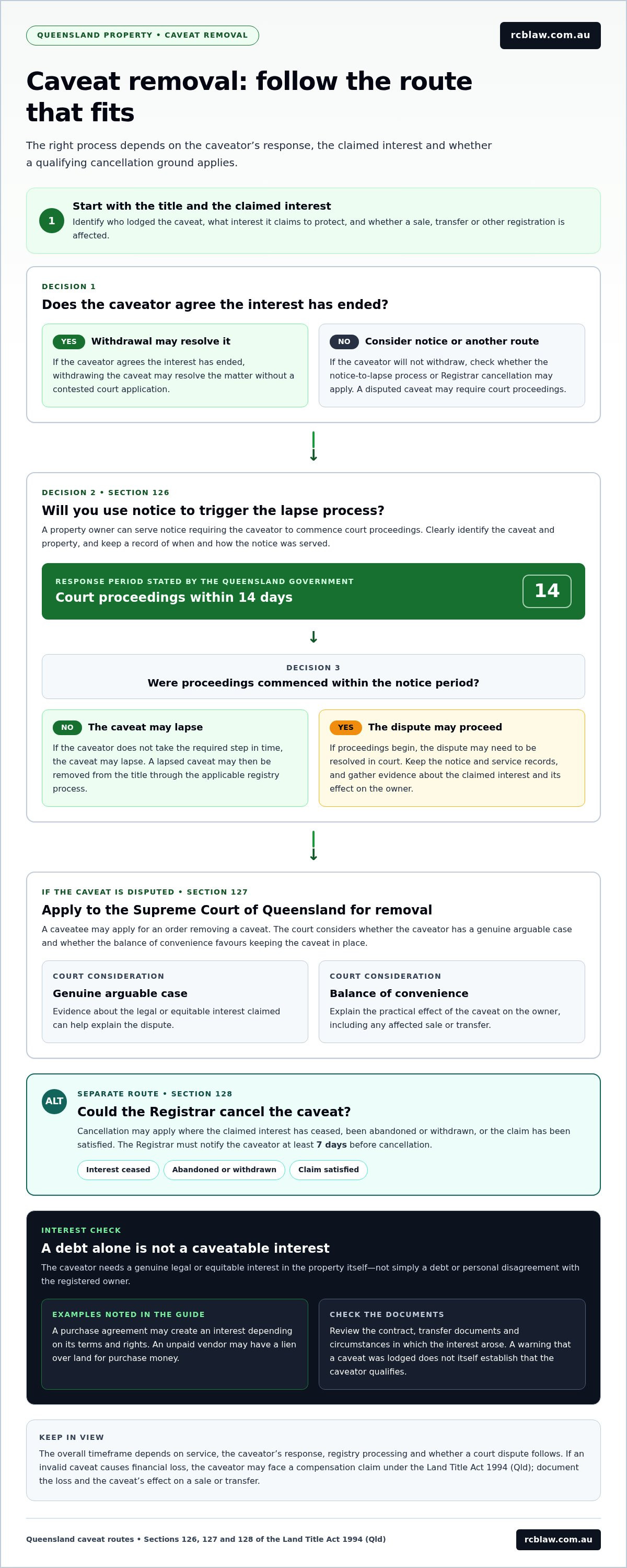
In Queensland, a caveat may be withdrawn, lapse after notice, or be cancelled in qualifying circumstances. The right process depends on the caveator’s response and whether the claimed interest is valid.
Lapsing a Caveat Through the Titles Office
Section 126 of the Land Title Act 1994 (Qld) provides for caveat lapsing. A property owner can start the process by serving the caveator with notice requiring court proceedings. If the caveator doesn’t take the required step in time, the caveat may lapse. Check who lodged the caveat, the interest claimed and whether a sale contract or proposed transfer is affected before lodging related documents with the titles registry.
Serving Notice to Trigger Removal
Notice alerts the caveator that the property owner is seeking to clear the title. It should clearly identify the caveat and property so the recipient knows which registered interest is being challenged. Keep a record of when and how notice was served, because the response period runs from service. If the caveator agrees the interest has ended, withdrawing the caveat may resolve the matter without a contested court application.
Caveator Response Deadlines
According to the Queensland Government, a caveatee can give a caveator notice requiring court proceedings to be commenced within 14 days, or the caveat may lapse. The caveator must decide whether to start proceedings to preserve the claimed interest. For an owner, record the date notice was served and monitor whether proceedings begin within the deadline. A caveat that lapses may then be removed from the title through the applicable registry process.
Removal Timeframes and Cancellation
The overall timeframe depends on service, the caveator’s response, registry processing and whether a court dispute follows. A lapse after notice is different from cancellation by the Registrar. Under section 128 of the Land Title Act 1994 (Qld), cancellation may apply where the claimed interest has ceased, been abandoned or withdrawn, or the claim has been satisfied. The Registrar must notify the caveator at least seven days before cancellation.
Lodging or maintaining an invalid caveat can expose the caveator to a compensation claim under the Land Title Act 1994 (Qld) if it causes financial loss. Document the loss and the caveat’s effect on a sale or transfer, as those details may matter when the claim is assessed.
What Counts as a Caveatable Interest?
A financial concern about land does not, by itself, give someone grounds to lodge a caveat. In Queensland, the caveator must have a genuine legal or equitable interest in the property. That interest must relate to the land itself, not simply to a debt or personal disagreement with the registered owner.
A purchase agreement may create an interest capable of supporting a caveat, depending on its terms and the rights it gives the purchaser. An unpaid vendor may also have a lien over land for purchase money. The Land Title Practice Manual (Queensland) refers to section 191 of the Land Title Act in connection with a vendor’s lien.
Before lodging a caveat, identify the specific right you are protecting and the document that creates it. Review the contract, any transfer documents and the circumstances in which the interest arose. A warning that a caveat has been lodged does not establish that the caveator qualifies. The relevant documents and the legal connection to the land matter.
Queensland cases show why the distinction matters. In Simons v David Benge Motors Pty Ltd [1974] VR 585, an agreement to share resale profits without security over the land was insufficient. In Re Rutherford [1977] 1 NZLR 405, a mere right of pre-emption did not support a caveat. These examples distinguish a contractual benefit from a proprietary interest.
Other claims also require careful analysis. Ex parte Goodlet and Smith Investments Pty Ltd [1983] 2 Qd R 792 found that mistakenly improving another person’s land was insufficient. In Walter v Registrar of Titles [2003] VSCA 122, a discretionary trust beneficiary lacked a caveatable interest in trust-owned land. Each illustrates why an agreement, payment or expectation alone may not establish the required interest.
For a proposed caveat or a challenge to one, assessing the property interest can help clarify how the documents relate to the land.
What a caveat is and what it does to a Queensland property title
A caveat is a legal notice recorded against a Queensland land title. It can prevent registration of certain dealings while it remains in place. For example, a proposed transfer may be affected, so a buyer or property owner should identify the caveat and the interest it claims to protect. The Land Title Act 1994 (Qld) provides the framework for caveats and related title processes.
A caveat’s effect depends on its wording and the dealing proposed. It does not transfer ownership to the caveator, but it can restrict registration until it is withdrawn, lapses or is removed. If you’re considering how to remove a caveat on a property in Brisbane, obtain the title details, read the caveat and note the interest claimed. Then identify whether it affects a sale, mortgage or other registration.
Under section 127 of the Land Title Act 1994 (Qld), a caveatee may apply to the Supreme Court of Queensland for an order removing a caveat. The court considers whether the caveator has a genuine arguable case and whether the balance of convenience favours keeping it in place. Evidence about the claimed interest and the practical effect on the owner can help explain the dispute.
A caveatee can also use a notice process. According to the Queensland Government, a caveatee can give a caveator notice requiring court proceedings to be commenced within 14 days, or the caveat may lapse. Keep proof of service and note the deadline. If proceedings begin, the dispute may need to be resolved in court.
If you’re asking how to remove a caveat on a property in Brisbane, the costs depend on the process required. Titles Queensland fees vary with the registry action, while court costs depend on the application and proceedings. Legal advice can help you assess the title, documents and proposed dealing before choosing a route.
Challenging a caveat through legal proceedings
When a caveator won’t withdraw a disputed caveat, the property owner can consider an application to the Supreme Court of Queensland. Section 127 of the Land Title Act 1994 (Qld) allows a caveatee to seek an order removing it. The application puts the claimed interest before the court, rather than relying solely on the caveator’s agreement or a registry process.
When deciding whether a caveat should remain, the court considers whether the caveator has a genuine arguable case and whether the balance of convenience favours keeping it in place. The evidence should explain the claimed connection to the land and the consequences of retaining or removing the caveat. A contract, transfer documents or relevant correspondence may help clarify the dispute and its effect on a proposed dealing.
Before applying, organise the key records into a clear chronology. Include the title details, caveat, documents said to create the interest and relevant communications between the parties. State the outcome you seek, such as removal of the caveat or an order addressing further caveats. Focus on evidence linking the caveator’s claim to the property, not just the history of the disagreement.
Court proceedings can require each side to explain its position and respond to the other’s evidence. The caveator may need to establish an arguable interest, while the owner can show how the caveat affects a sale, transfer or other property dealing. The court may also order that no further caveats be lodged. After removal, a caveator can lodge another caveat only if a new caveatable interest arises.
Lawyers can help assess the documents, frame the application and present the property impact clearly. That preparation matters when litigation could affect a contract or delay a transaction. For guidance on the legal steps in a caveat dispute, discuss your property matter.
RCB Law: Residential Conveyancing
RCB Law provides residential conveyancing for people dealing with caveats affecting a home purchase, sale or transfer. Because a caveat can complicate a property transaction, it is important to understand its status and what steps may allow the dealing to proceed.
Commercial property law may be relevant when a caveat affects a commercial property matter. The appropriate support depends on the property and transaction, including whether the caveat has been withdrawn, lapsed or remains disputed. Gathering the title details and transaction documents can help clarify the issue.
If a caveat is affecting your property plans, contact RCB Law to discuss your circumstances and next steps.
Take the Next Step With Clarity
A caveat dispute can affect more than the title, particularly when a planned sale, purchase or business arrangement depends on the property. Before taking action, gather the title record, caveat documents and any agreements or correspondence connected with the claimed interest. These records give legal advice a practical starting point.
If you’re deciding how to remove a caveat on a property in Brisbane, RCB Law can help you assess the property issues involved. Its residential conveyancing, commercial property law and business law services may be relevant when a caveat affects a home transaction, commercial property or business matter.
Contact RCB Law about your caveat matter to discuss a considered next step. With a clearer view of the documents and your options, you can move forward with greater confidence.
Frequently Asked Questions
Who can lodge a caveat in Queensland?
A person with a genuine legal or equitable interest in land may be eligible to lodge a caveat. The claim must connect to the property itself, not merely to a personal or financial dispute. For example, a contract may give a purchaser rights relating to land. Before lodging, identify the interest being protected and ensure the caveat accurately reflects the documents and circumstances.
Does a caveat expire automatically?
No. A caveat may remain on a Queensland title indefinitely unless it is withdrawn, removed or lapses through an available process. Some caveats do not lapse, including those lodged by or with the registered owner’s consent, under a court order, or by the Registrar of Titles. For other caveats, a property owner may take steps to trigger a response deadline. The outcome depends on the caveat and the action taken.
What is a caveat on a property title in Queensland, and what does it do?
A caveat is a notice recorded on a Queensland land title that can restrict registration of certain dealings. It does not make the caveator the owner, but it may affect a planned sale, mortgage or transfer. A buyer reviewing a property should consider the interest stated in the caveat and how it relates to the proposed transaction. The title entry flags an issue to resolve before proceeding with an unrestricted dealing.
How can a property owner check for a caveat on a Queensland land title?
A property owner can obtain a title search through Titles Queensland and review the registered interests shown for the land. Confirm that the title details match the correct property, then check for a caveat entry and its identifying information. If a sale or refinance is planned, compare the search with the contract and proposed dealing. A recent search shows the title as it stood when the search was issued.
How do you withdraw or remove a caveat in Queensland using Titles Queensland forms?
The caveator can withdraw a caveat by lodging the applicable withdrawal request with the land titles registry. Use the current Titles Queensland form and ensure the property and caveat details are correct. If the caveator will not withdraw it, the property owner may need to consider a lapsing or court process. The owner cannot sign a withdrawal on the caveator’s behalf.
What is a lapsing notice, and how can a Brisbane property owner use one to remove a caveat?
A lapsing notice gives the caveator an opportunity to start court proceedings to preserve the caveat. According to the Queensland Government, a caveatee can give a caveator notice requiring proceedings to commence within 14 days, or the caveat may lapse. A Brisbane owner should keep evidence of when notice was served and monitor the response. The notice starts a process, rather than deleting the caveat immediately.


