
Imagine opening your first quarterly levy notice only to discover a "special contribution" for roof repairs that costs more than your monthly mortgage. While purchasing property is an exciting milestone, the legal differences between buying a unit versus a house in QLD can mean the difference between a secure investment and a series of stressful financial surprises. When you buy a house, you generally acquire a Torrens Title, giving you total control over the land. Buying a unit means entering a community titles scheme, where your rights are shared and governed by a body corporate.
It's natural to feel overwhelmed by complex contracts and disclosure statements. You deserve to feel certain that your new home won't come with hidden liabilities or restrictive by-laws. At RCB Law, our goal is to act as your steady guide, simplifying the technical language of the Body Corporate and Community Management (BCCM) Act. We'll provide the clarity you need to sign your contract with confidence and reach settlement without any unexpected hurdles.
This 2026 guide breaks down the latest seller disclosure requirements under the Property Law Act 2023. We will also examine how recent changes to pet ownership and smoking by-laws affect your lifestyle choices and maintenance responsibilities.
Key Takeaways
- Understand the fundamental legal distinction between owning land outright with a Torrens Title and sharing ownership through a Community Title Scheme.
- Learn why the Body Corporate Disclosure Statement is your most vital tool for uncovering hidden costs or restrictive by-law changes.
- Discover the specific legal differences buying a unit vs house qld within standard REIQ contracts to ensure your interests are protected before you sign.
- Gain clarity on your insurance and maintenance obligations, including which parts of the property fall under your personal responsibility.
- Identify how expert contract reviews and fixed-price conveyancing provide the certainty needed for a successful settlement in the 2026 market.
Torrens Title vs. Community Title: The Legal Foundation
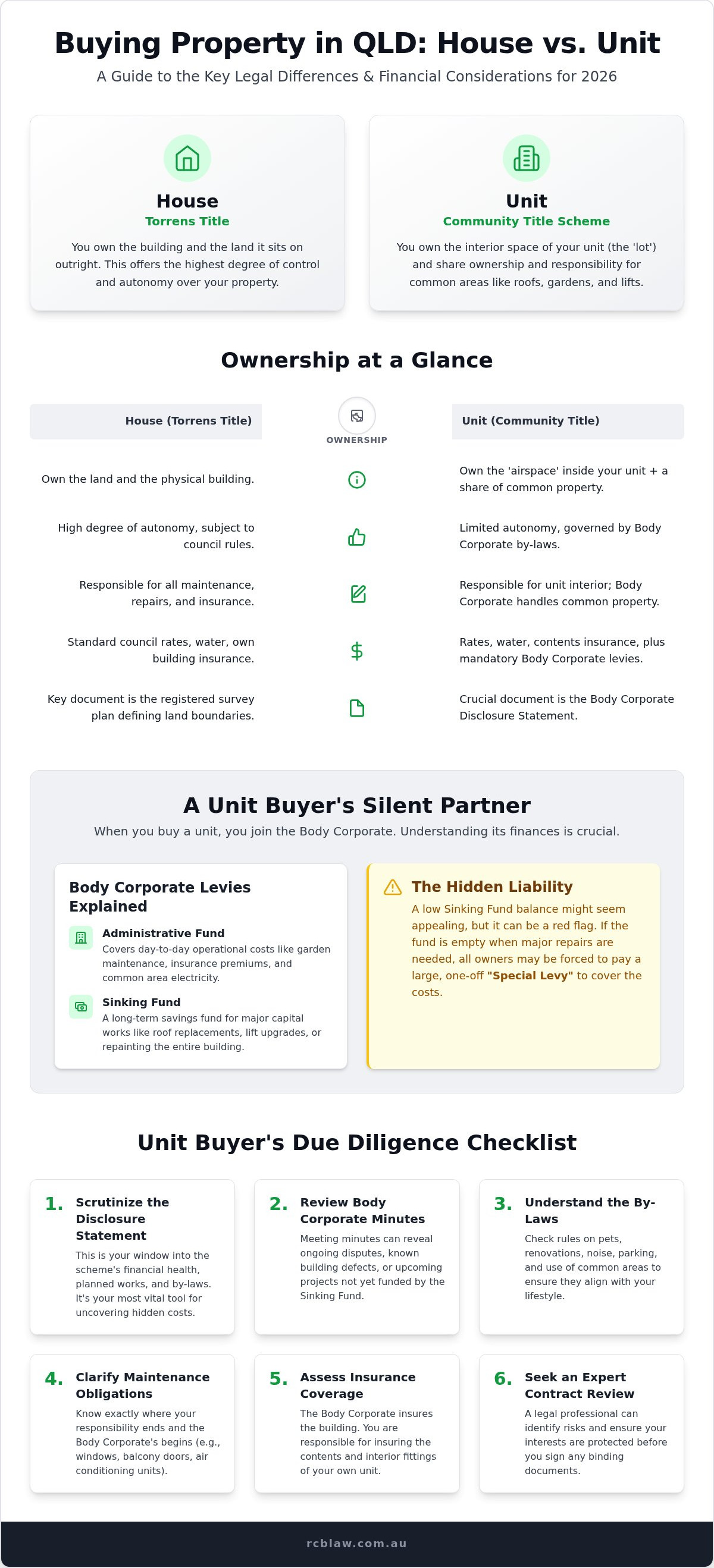
Buying a home in Queensland is a significant journey. The legal foundation of your purchase depends on the type of title you're acquiring. When you buy a standalone house, you typically receive a Torrens Title. This means you own the land and the building sitting on it entirely. It's the most direct form of ownership available. However, the legal differences buying a unit vs house qld become clear when you look at multi-dwelling complexes. These are governed by a Community Title Scheme (CTS) under the Body Corporate and Community Management Act 1997.
In a CTS, ownership is split. You own your specific unit but share "common property" with other owners. Common property can include the roof, gardens, driveways, and elevators. This shared responsibility is often referred to as Strata Title. Understanding this distinction is vital because it affects how you use your property and who pays for repairs. It also dictates how much freedom you have to change the appearance of your home.
Understanding Your Boundaries
In a house purchase, your boundaries are defined by a registered survey plan. This document shows the exact corners and dimensions of your land. In a unit, your "lot" is usually defined by the interior surfaces of the walls, floor, and ceiling. Everything outside those boundaries is likely common property. The process of conveyancing for a unit requires a deeper investigation into the scheme's records. We look for boundary disputes or structural issues lurking in the common areas that could impact your future enjoyment of the property.
Control and Autonomy
House owners generally enjoy more legal freedom. If you want to paint your facade or build a deck, you usually only need to comply with local council zoning and building codes. Unit owners face an extra layer of regulation through the body corporate. Even minor changes, like installing an air conditioner or changing your window coverings, might require formal approval from the committee.
Community Title is a shared legal interest in a larger scheme. This means your autonomy is balanced against the collective interests of your neighbors. One of the key legal differences buying a unit vs house qld is that your rights are tied to the by-laws of the complex. These rules can be more restrictive than council regulations, impacting everything from where you park to how you use outdoor spaces.
The Body Corporate: A Unit Buyer's Silent Partner
When you purchase a unit, you aren't just buying a home; you're joining a legal entity. The Body Corporate and Community Management Act 1997 (QLD) governs this relationship. It ensures the scheme operates fairly, but it also introduces one of the primary legal differences buying a unit vs house qld: the requirement for a Disclosure Statement (Form 14). This document is your window into the scheme's financial health and rules. While a house buyer relies on their own building inspections, a unit buyer must scrutinize this statement to avoid inheriting the debts or legal problems of the collective group.
You'll encounter two main types of levies. Administrative fund levies cover day-to-day running costs like garden maintenance, insurance premiums, and electricity for common areas. Sinking fund levies are for the future. They fund major capital works like roof replacements, lift upgrades, or repainting the entire building facade. Understanding the balance between these two funds is essential for your long-term financial security.
The Sinking Fund and Hidden Liabilities
A common mistake is assuming lower levies are always better. In reality, a low sinking fund balance might signal that the body corporate isn't prepared for upcoming repairs. If the fund is empty when a major structural issue arises, owners may be hit with a "special levy" for thousands of dollars. We protect our clients by reviewing committee minutes to identify planned works that haven't been funded yet. For more information on your rights as an owner, you can visit the Office of the Commissioner for Body Corporate and Community Management. Having a professional contract review ensures you understand these governance structures before you commit to the purchase.
By-Laws: The Rules of the Community
By-laws are the local laws of your complex. As of 2026, Queensland law has evolved significantly regarding these rules. For instance, blanket bans on pets are no longer permitted, and bodies corporate now have stronger powers to tow vehicles parked in contravention of the rules. In high-demand areas like Brisbane and the Sunshine Coast, we often see strict by-laws regarding short-term rentals to preserve the residential character of the building.
- Pets: Requests must be assessed reasonably; they cannot be flatly refused.
- Smoking: Bodies corporate can now prohibit smoking in common and outdoor areas.
- Towing: New regulations allow for more efficient removal of unauthorized vehicles.
You also have a legal right to attend meetings and vote on complex matters. This level of participation is entirely different from owning a house, where you make all decisions in isolation. Being an active member of the body corporate allows you to influence how your levies are spent and how the community is managed.
Contractual Differences and Disclosure Obligations
The legal differences buying a unit vs house qld are most visible when you look at the physical contract sitting on your desk. For a standalone house, you will typically use the REIQ "House and Residential Land" contract. This document focuses on the land, the dwelling, and any registered encumbrances like easements. However, purchasing a unit requires the "Residential Lots in a Community Titles Scheme" contract. This version is more complex because it must account for your shared interest in the larger scheme and the body corporate's financial standing.
One critical protection in unit contracts is the "Seller's Warranty." The seller legally guarantees that, to their knowledge, there are no latent structural defects in the common property and no unsatisfied judgments against the body corporate. In a house contract, the burden of discovery usually rests almost entirely on your building and pest inspection. Both property types carry a standard five-business-day cooling-off period in Queensland, which begins the day you receive a copy of the contract signed by both parties. Despite this safety net, having a professional review your contract before you sign is the best way to avoid a high-pressure situation later.
The New Build and Off-the-Plan Trap
Buying off-the-plan in high-growth areas like the Sunshine Coast or Brisbane offers modern living but introduces unique legal risks. Sunset clauses are a major concern; these allow a contract to be terminated if the project isn't finished by a specific date. While Queensland laws now provide more protection against developers using these clauses unfairly, the uncertainty can still be taxing. If you're looking at a new build, you might be eligible for the First Home Buyers Grant QLD, which provides a $30,000 incentive for new homes valued under $750,000. We help you weigh these financial benefits against the contractual risks of a property that doesn't exist yet.
Disclosure Failures: Can You Terminate?
A seller's failure to provide a complete and accurate Disclosure Statement is one of the few ways a buyer can legally terminate a unit contract before settlement. If the statement is missing vital information about levies or by-laws, you may have a right to walk away. However, the law requires you to prove "material prejudice." This means the undisclosed information must be significant enough to negatively affect your decision to buy. Our team identifies these discrepancies early. We look for hidden details that a standard search might miss, ensuring you aren't locked into a contract that doesn't reflect the reality of the property.
Maintenance, Insurance, and Liability
One of the most practical legal differences buying a unit vs house qld is how you protect and maintain your asset over time. When you own a standalone house, you're the sole decision-maker and the sole financier for every repair, from a cracked tile to a major structural failure. In high-density areas of Brisbane or the Sunshine Coast, unit owners operate within a collective. This shared responsibility can reduce your individual workload, but it also means you're bound by the group's financial decisions and maintenance schedules.
Insurance Obligations in QLD
If you're buying a house, you need to act quickly once the contract is signed. In Queensland, the risk for the property typically passes to the buyer at 5pm on the first business day after the contract date. You must have building and public liability insurance "on cover" immediately to protect your interest. Conversely, unit owners generally don't need to worry about insuring the building's external structure or common areas. The body corporate is legally required to take out a comprehensive policy for the entire complex, the cost of which is included in your levies.
However, you shouldn't assume you're fully covered. Unit owners must follow the "Inside the Walls" rule. You're responsible for insuring your own contents and any fixtures that aren't part of the common property, such as carpets, curtains, and internal cabinetry. It's also vital to understand how land tax applies to your purchase. While your principal place of residence is usually exempt, the way land value is calculated for a unit share differs significantly from a standalone block of land.
Repairing the Property
The legal process for repairs depends heavily on your title type. Imagine a leaking roof. If you own a house, you hire the plumber and pay the bill yourself. House owners bear 100% of the risk for structural defects found post-settlement. If you own a top-floor unit, the roof is almost always common property. This means the body corporate is responsible for the cost and coordination of the repair. You must formally notify the committee or the body corporate manager to initiate the work, which can sometimes take longer than managing a repair privately.
Maintenance disputes also take different paths. House owners navigate disagreements over dividing fences under the Neighborhood Disputes (Dividing Fences and Trees) Act. For unit owners, disputes about common property or balcony repairs are handled through the body corporate committee or the Commissioner’s office. If you're feeling anxious about these ongoing responsibilities, our expert property law team can help you review the scheme's maintenance history and insurance certificates before you commit.
How RCB Law Guides Your QLD Property Purchase
Buying your first home is one of the most significant life events you'll experience. It's often a high-pressure transition, especially when you're trying to decode the legal differences buying a unit vs house qld. With over 30 years of experience in the Sunshine Coast and Brisbane property markets, we've seen every type of contract and disclosure trap. We act as your steady guide, ensuring that the journey from an initial offer to a successful settlement is as smooth as possible. Our expertise allows us to anticipate potential friction before it becomes a problem for you.
Our fixed-price residential conveyancing provides the budget certainty you need during a time of high expenses. You won't face hidden fees or surprise costs at the end of the process. We prioritize proactive communication because we know that silence from a solicitor creates unnecessary anxiety. You'll always know exactly where your file stands, whether we're verifying a body corporate's insurance certificate or checking land title boundaries for an established house. This structured approach helps transform a state of uncertainty into a feeling of total security.
The Value of a Local Specialist
Regional knowledge is essential in the 2026 market. We understand the track records of developers across South East Queensland, which is vital if you're considering an off-the-plan purchase. We don't just process paperwork; we look for the "material prejudice" issues that could allow you to terminate a contract if the seller fails their disclosure obligations. Beyond the property itself, we help you look at the bigger picture. Acquiring a significant asset is the perfect time to ensure your will is updated. This ensures your new home is protected and your wishes are clear for the future.
Getting Started with RCB Law
Engaging our team is simple and direct. First, send us your draft contract before you sign it. We'll perform a detailed review to ensure you're eligible for all available grants, such as the A$30,000 First Home Owner Grant for new builds or the latest stamp duty concessions. Once the contract is live, we handle all the heavy lifting. We manage the title searches, coordinate with your bank, and oversee the digital settlement process. We're here to provide the clarity and confidence you need to secure your future in Queensland. Contact us today for a free assessment of your property contract and take the first step toward a successful settlement.
Taking the Next Step in Your Queensland Property Journey
Choosing between a standalone house and a community-titled unit involves more than just lifestyle preferences. It's a choice between different legal frameworks and long-term responsibilities. Understanding the legal differences buying a unit vs house qld ensures you aren't blindsided by unexpected body corporate levies or structural maintenance costs after settlement. Whether you're drawn to the autonomy of a Torrens Title home or the shared community of a modern unit, the key to a successful purchase lies in a thorough contract review and expert due diligence.
We recognize that the property market can feel high-pressure. Our team brings 30+ years of Queensland property expertise to every transaction, serving as your steady guide through the Sunshine Coast and Brisbane markets. We provide fixed-price certainty to alleviate financial stress, allowing you to focus on the excitement of your new home. You've worked hard for this milestone; we're here to make sure the legal process is the easiest part of your move.
Get a Fixed-Price Conveyancing Quote from RCB Law today to secure your property future with confidence. Your path to a successful settlement starts with the right advice.
Frequently Asked Questions
Is it legally harder to buy a unit than a house in QLD?
The process isn't necessarily harder, but the due diligence required is more complex. While house purchases focus on the land and physical structure, units require a deep investigation into the body corporate's financial health and governance. The legal differences buying a unit vs house qld mean you must review a Disclosure Statement, which isn't part of a standalone house contract. This extra layer of documentation provides essential protections for community living.
What is a Body Corporate Disclosure Statement and why do I need it?
A Disclosure Statement is a mandatory legal document that a seller must provide before you sign a unit contract. It contains vital information about the community titles scheme, including current levies, insurance details, and any known liabilities. You need it because it reveals the financial stability of the complex. Without this document, you might unknowingly inherit significant debts or legal disputes. Reviewing this statement is critical to understanding the legal differences buying a unit vs house qld.
Do I own the land under my unit in Queensland?
You don't own the specific patch of land under your unit in the same way a house owner owns their block. Instead, you own your "lot" and a shared interest in the common property as a tenant in common with other owners. This shared interest includes the land the building sits on. This legal structure ensures that all owners collectively manage the land and facilities through the Body Corporate and Community Management Act.
Can the Body Corporate stop me from having a pet?
As of 2026, Queensland law prevents bodies corporate from implementing blanket bans on pets. While they can't flatly refuse your request, they can impose reasonable conditions to ensure the pet doesn't disturb other residents. For example, they might require you to keep your pet on a lead in common areas. If a body corporate unreasonably refuses a pet request, you have the right to challenge that decision through the Commissioner's office.
Who is responsible for fixing a balcony leak in a QLD unit?
Responsibility usually depends on whether the leak originates from the common property or the internal lot. In most Queensland schemes, the body corporate is responsible for maintaining the building's exterior and structural elements, which often includes the balcony's waterproof membrane. However, if the leak is caused by damage you've done to the tiles or internal plumbing, the repair cost may fall on you. We recommend checking your specific survey plan to confirm boundaries.
Are the cooling-off periods the same for units and houses?
Yes, both residential houses and units in Queensland carry a standard five-business-day cooling-off period. This period begins the day you receive a copy of the contract signed by both you and the seller. If you choose to terminate the contract during this window, the seller may charge a penalty of 0.25% of the purchase price. It's a vital safety net that allows you to reconsider the purchase after the initial negotiations.
What happens if the Body Corporate has no money in the sinking fund?
If the sinking fund is empty when major repairs are needed, the body corporate will likely strike a "special levy." This means all owners are legally required to pay a lump sum to cover the costs, which can sometimes reach tens of thousands of dollars. This is why we prioritize reviewing the sinking fund forecast and committee minutes. Ensuring the scheme is financially prepared for the future is essential for your long-term peace of mind.
Should I get a building and pest inspection for a high-rise unit?
You should always get a professional inspection, even for a modern high-rise apartment. While the body corporate is responsible for the main structure, an inspection can identify issues inside your lot, such as faulty wiring, plumbing leaks, or poor workmanship. It also provides a record of the unit's condition at the time of purchase. For units, we also suggest a body corporate record search to uncover structural issues affecting the entire building.


