
What if a single missing document gave your buyer the legal right to walk away from your home sale just days before settlement? With the full implementation of the Property Law Act 2023, the margin for error has vanished. Understanding the legal requirements for selling a house qld is no longer just about ticking boxes; it's your primary defense against a failed contract. We know that selling your home is one of life's most high-pressure transitions, especially when navigating the specific local requirements of the Sunshine Coast or Brisbane. It's natural to feel anxious about the mandatory Form 2 Seller Disclosure Statement or the strict identity checks that now apply to every transaction.
You deserve a process that feels clear and controlled rather than chaotic. This 2026 guide is designed to help you navigate Queensland's complex property laws with confidence, ensuring a legally compliant and smooth sale. We'll provide a structured breakdown of your disclosure obligations, the latest AML/CTF identity requirements, and the essential safety standards for smoke alarms. By the end of this article, you'll have a clear roadmap to secure your settlement and protect your hard-earned equity. Let's replace that uncertainty with a feeling of security as you prepare for your next chapter.
Key Takeaways
- Learn why the mandatory Form 2 Seller Disclosure Statement is now your most important legal document to prevent a buyer from terminating the contract.
- Understand the new 2026 identity verification requirements (AML/CTF) that all Queensland sellers must complete to remain compliant with federal law.
- Identify the specific legal requirements for selling a house qld regarding interconnected smoke alarms to ensure your property meets safety standards before settlement.
- Gain clarity on the cooling-off period and "subject to" clauses to protect your interests during the high-pressure window between contract and completion.
- Discover how local Sunshine Coast and Brisbane legal expertise provides a steady guide through complex paperwork, helping you avoid the risks of national conveyancing mills.
Selling a House in QLD: The 2026 Legal Landscape
Queensland property laws have always been some of the most rigorous in Australia. In 2026, the stakes are even higher due to the full implementation of the Property Law Act 2023. For decades, the market operated under "caveat emptor" or "buyer beware." Today, that has shifted toward a regime of mandatory seller disclosure. This change means that the legal requirements for selling a house qld now place a significant burden of proof on you, the homeowner, before the contract is even signed.
We understand that this shift can feel overwhelming. Selling your family home or an investment property is a major life transition, often accompanied by high pressure. Having legal clarity from the start is the best way to reduce this emotional burden. When you know exactly what documents are needed, the fear of a sale falling through at the last minute begins to fade. It's about creating a sense of calm and confidence in a process that often feels anything but simple.
The 'Time is of the Essence' Rule
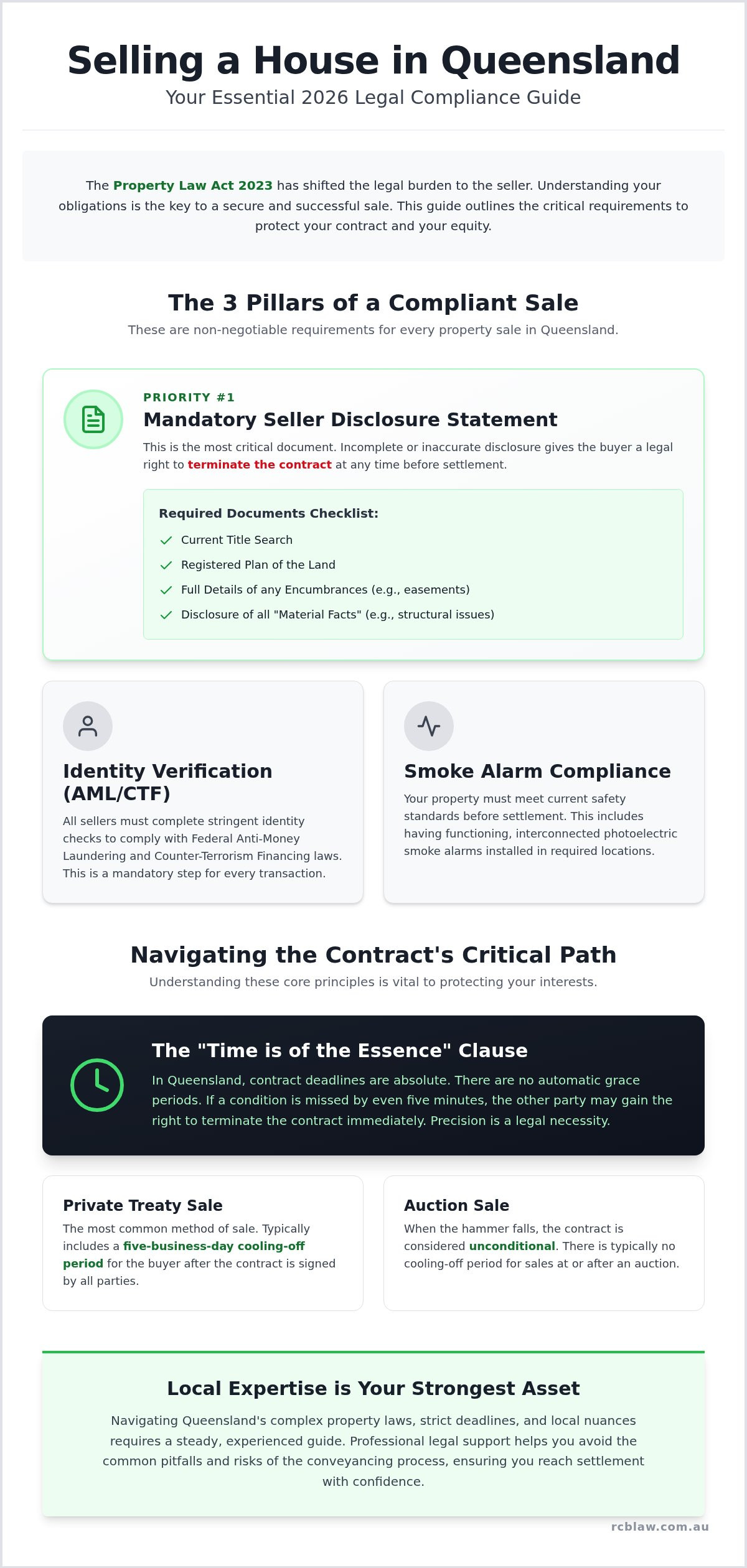
One of the most critical aspects of the Queensland conveyancing process is the "Time is of the Essence" clause. Unlike other states where deadlines might be somewhat flexible, Queensland law is uncompromising. If a contract condition, such as finance or building and pest, is due at 5:00 PM on a Friday and it's missed by even five minutes, the other party may have the right to terminate the contract immediately. There's no automatic grace period.
Your solicitor acts as your steady guide through this rigid calendar. We manage these strict deadlines to protect your interests and ensure the buyer remains committed. If a buyer defaults, you may be entitled to keep the deposit. Conversely, if a seller defaults on a deadline, the buyer can terminate and potentially sue for damages. Precision isn't just a preference; it's a necessity.
Methods of Sale: Legal Implications
Your chosen method of sale significantly alters the legal landscape. In a private treaty sale, the buyer usually benefits from a five-business-day cooling-off period. However, if you sell at an auction, the contract is typically unconditional the moment the hammer falls. Most residential transactions in Queensland utilize the REIQ Contract of Sale, which provides a standardized framework but still requires careful customization to your specific property.
Choosing the right method depends on your timeline and your comfort level with risk. For more detail on how these steps fit together, you can read our article on What is Conveyancing? Your Complete Guide to Buying & Selling Property in QLD. Meeting the legal requirements for selling a house qld starts with choosing a team that understands the regional nuances of the Sunshine Coast and Brisbane markets.
The Mandatory Seller Disclosure Statement: Your #1 Priority
The introduction of the mandatory Form 2 Seller Disclosure Statement (SDS) represents the most significant shift in Queensland property law in over forty years. Since August 1, 2025, sellers have been legally required to provide this statement and all prescribed certificates to a buyer before the contract is signed. This requirement is now the cornerstone of the legal requirements for selling a house qld. If the information you provide is incomplete or inaccurate, the buyer typically gains a powerful legal right to terminate the contract at any time before settlement. While this might sound daunting, it actually provides a structured path to a more transparent and secure transaction.
To be legally valid, the SDS must include several mandatory documents. You'll need to provide a current title search, a plan of the land, and full details of any registered encumbrances. Beyond these physical documents, you're obligated to disclose "material facts." These are specific details that could reasonably influence a buyer's decision to purchase, such as structural issues or certain historical events associated with the property. Following the Queensland Government guidelines ensures you don't miss these vital components. If you're feeling overwhelmed by the paperwork, our team at RCB Law can help you review your disclosure obligations to ensure your sale stays on track.
Title Searches and Easements
A title search does more than confirm you own the property. It identifies registered interests that must be disclosed to the buyer, such as easements. An easement might grant a utility provider or a neighbor the right to use a portion of your land. If an undisclosed easement is discovered after the contract is signed, it can derail a settlement at the last minute. It's also vital to check for any legal warnings or restrictions on the title. You can learn more about these specific interests in our guide on What is a Caveat? A Plain English Guide for Property in Queensland.
Body Corporate Disclosures for Units and Townhouses
Selling a property within a community title scheme adds another layer of responsibility. You must provide a body corporate disclosure statement that outlines the financial health of the scheme. This includes current sinking fund balances, administrative levies, and insurance details. Buyers in 2026 are more diligent than ever about committee minutes and potential special levies. Because these documents are technical and time-sensitive, body corporate disclosure is a high-risk area for sellers. A single missing certificate could give a buyer the legal loophole they need to walk away for free, making professional verification a critical step for your peace of mind.
Appointing Your Professional Team: Agents and Solicitors
Deciding to sell your home is a significant life milestone that marks the beginning of a high-pressure transition. To move through this process with confidence, you need a professional team that acts as a steady guide. The first legal document you'll likely encounter is the Form 6. This is the official appointment of a real estate agent. It's a legally binding contract that outlines the agent's authority, the duration of the appointment, and the commission structure. In 2026, real estate commissions in Queensland remain deregulated. Most sellers find that average commissions range between 2.45% and 2.8% of the sale price, typically excluding GST and marketing costs.
You'll also need to decide between an exclusive or open listing. An exclusive agency appointment gives one agent the sole right to sell your property for a specific period. This often results in a more focused marketing effort. An open listing allows you to engage multiple agents, but it can lead to confusion and disputes over who actually introduced the buyer. Because the Form 6 is a contract, you should have a property lawyer review it before you sign. We've seen many homeowners inadvertently lock themselves into long-term agreements or high marketing expenses that don't align with their needs. Local knowledge of the Sunshine Coast and Brisbane property markets is essential here, as regional council compliance can vary significantly.
While REIQ's eight steps for selling provide an excellent roadmap, having a solicitor on your side ensures every legal detail is handled with precision. This proactive approach helps remove friction before it becomes a problem.
Conveyancer vs. Solicitor: Choosing Your Legal Representative
Many sellers aren't sure whether to hire a conveyancing clerk or a specialist property lawyer. While a clerk can handle standard paperwork, a solicitor provides a much higher level of protection. If the legal requirements for selling a house qld become a point of conflict or the sale turns sour, a solicitor has the expertise to handle complex litigation and provide high-level advice. We offer fixed-fee conveyancing services. This gives you the mastery of a seasoned professional with 30 years of experience while ensuring budget certainty from day one.
Seller Identity Verification (AML/CTF)
As of July 1, 2026, all property sellers in Australia must comply with strict identity verification requirements. These Tranche 2 AML/CTF reforms mean you must complete a formal Verification of Identity (VOI) process before your property is even listed. It's no longer a simple matter of showing a passport; your agent and solicitor are both legally required to verify your "proof of life." We recommend starting this process early. Providing your documents to your legal team at the start of your journey prevents frustrating delays when you're ready to go to market.
From Contract to Settlement: Navigating the Critical Path
Once the contract is signed, you enter a period where precision becomes your greatest asset. The first milestone is the cooling-off period. In Queensland, residential buyers generally have five business days to change their mind. If they withdraw during this window, they must pay a penalty of 0.25% of the purchase price. While this provides the buyer with a safety net, it's often a time of high anxiety for sellers. Having a steady guide to manage these early days ensures you don't lose momentum if a buyer gets cold feet.
Most contracts are also "subject to" specific conditions like finance approval or building and pest inspections. These aren't just checkboxes; they are legal hurdles that must be cleared within strict timeframes. Meeting the legal requirements for selling a house qld requires a methodical approach to these dates. If a buyer isn't satisfied with their inspections, they may attempt to negotiate a price reduction or terminate the contract. We step in to handle these communications, ensuring your interests remain protected while keeping the sale on track toward settlement.
Handling Buyer Requests for Extensions
It's common for buyers to request a finance extension. While your instinct might be to agree to keep the deal alive, granting an extension should be a strategic decision. We help you evaluate the risk. Is the buyer genuinely close to approval, or is the deal failing? If a buyer defaults on a deadline without a formal extension, you may have the right to terminate the contract and forfeit their deposit. Our role is to provide the legal clarity needed to make these high-pressure decisions with confidence.
The Settlement Day Timeline
In 2026, the final transfer of ownership is almost entirely digital. We use the PEXA platform to automate the transfer of title and the distribution of funds. This technology has removed the friction of physical meetings and the delay of waiting for bank cheques to clear. Before the final payout, we calculate "adjustments." These ensure you only pay for council rates, water, and Land Tax up until the exact day of settlement. For a deeper look at these costs, see our guide on Land Tax in Queensland: A Plain English Guide for Property Owners.
Settlement day is the culmination of your hard work. Because PEXA handles the distribution in real time, you'll often see the funds in your account much faster than in the past. If you want to ensure your final payout is calculated with absolute accuracy, contact RCB Law for a fixed-fee conveyancing quote today.
RCB Law: Your Steady Guide Through the Selling Process
Selling your home is more than a transaction; it's a significant life event that often carries a heavy emotional burden. We believe that your legal team should do more than just process paperwork. For over 30 years, RCB Law has acted as a steady guide for Queenslanders navigating these high-pressure transitions. Our approach is built on empathy and professionalism, ensuring you feel supported from the moment you decide to list until the final funds are cleared in your account. By focusing on residential conveyancing, we've developed a deep mastery of the specific legal requirements for selling a house qld.
Unlike national "conveyancing mills" that treat every file the same, we provide tailored advice based on regional expertise. Our teams in Brisbane and the Sunshine Coast understand local council requirements and the specific nuances of the South East Queensland market. We also remove the friction of financial uncertainty by offering fixed-fee conveyancing. This means you won't have to worry about escalating costs or hidden disbursements. You get the peace of mind that comes with knowing exactly what your legal investment will be from the very start of the process.
Beyond the Sale: Protecting Your New Assets
Settlement day marks the end of one chapter, but it also signals the start of another. When you sell a property, your financial circumstances change significantly, making it the perfect time to review your estate planning. Protecting your new assets is just as important as the sale itself. We assist our clients with this "next chapter," whether you're reinvesting in a new home or diversifying your portfolio. As a post-sale value-add, we offer complimentary Will reviews to ensure your wishes are up to date. You can explore why this is a vital step in our guide on Why You Need a Will: A Comprehensive Guide for Queenslanders.
Start Your Selling Journey with Confidence
You don't have to wait until you have a signed contract to seek legal support. In fact, our most successful clients engage us early to ensure all legal requirements for selling a house qld are met before the first open home. We take a proactive approach to preparing your Disclosure Statement, identifying potential issues like undisclosed easements or title caveats before they can derail a sale. This preparation is the best insurance against a buyer pulling out at the last minute.
If you're ready to move forward, contact our Sunshine Coast or Brisbane teams for a reassuring consultation. We'll provide a clear, fixed-fee quote and a structured breakdown of the steps ahead. Let us take the legal weight off your shoulders so you can focus on your move with total confidence.
Secure Your Settlement with Professional Guidance
Successfully navigating the legal requirements for selling a house qld doesn't have to be a source of anxiety. By prioritizing the mandatory Seller Disclosure Statement and understanding the digital mechanics of a PEXA settlement, you've already taken the first steps toward a secure transaction. It's vital to remember that Queensland's unique "Time is of the Essence" rule makes precision your most valuable asset during the critical path to completion. Small errors in paperwork or missed deadlines shouldn't be the reason your sale falls through at the last minute.
At RCB Law, we act as your steady guide through these high-pressure transitions. With over 30 years of Queensland property expertise, our lawyer-led service ensures that every detail is managed with the care it deserves. Whether you're in Brisbane or on the Sunshine Coast, our local specialists are here to remove the friction from your property sale. Request a fixed-fee conveyancing quote from RCB Law, protect your sale today. We're ready to help you transition into your next chapter with total confidence and the security of a professional partner by your side.
Frequently Asked Questions
What are the mandatory seller disclosure requirements in QLD for 2026?
Sellers must provide a Form 2 Seller Disclosure Statement and all prescribed certificates to the buyer before the contract is signed. This package includes a current title search, land plans, and details of any registered encumbrances or easements. You're also legally obligated to disclose "material facts" that could impact a buyer's decision. Failing to meet these legal requirements for selling a house qld can give the buyer a right to terminate the contract at any time before settlement.
Do I need a lawyer to sell my house in Queensland?
While you aren't strictly required by law to hire a lawyer, engaging one is the best way to protect your equity. In 2026, the complexity of mandatory disclosures and digital settlement via PEXA makes professional guidance essential. A specialist solicitor handles contract reviews, manages strict deadlines, and provides a level of legal protection that a conveyancing clerk cannot. This ensures your transition is low-friction and legally secure from start to finish.
How long is the cooling-off period for a seller in QLD?
There is no cooling-off period for a seller in Queensland once the contract is signed and communicated. Only the buyer typically benefits from a five-business-day cooling-off window for residential property sales. If a buyer chooses to withdraw during this time, they must pay a penalty of 0.25% of the purchase price to the seller. Because the seller is legally bound immediately, having your solicitor review the contract before you sign is a critical step.
What happens if a buyer pulls out of a house sale in QLD?
The outcome depends on why the buyer is withdrawing. If they pull out during the cooling-off period, you're entitled to the 0.25% penalty. If they fail to meet a "subject to" condition like finance or building and pest, they can usually terminate without penalty. However, if a buyer defaults on an unconditional contract, you may be entitled to forfeit their entire deposit and potentially sue for damages. We provide steady guidance to protect your interests in these situations.
What are 'outlays' in conveyancing and who pays for them?
Outlays, also known as disbursements, are the third-party costs your solicitor pays on your behalf during the legal requirements for selling a house qld. These include title searches, land tax certificates, and PEXA platform fees. As the seller, you're responsible for the costs associated with proving your title is clear and preparing the mandatory disclosure statement. We provide fixed-fee quotes that clearly outline these costs, so you don't face unexpected financial surprises during the settlement process.
Can I sell my house in QLD without a real estate agent?
Yes, you can legally sell your property privately in Queensland without appointing an agent. This is often called a "for sale by owner" transaction. While you save on agent commissions, you take on the full responsibility for marketing, inspections, and negotiations. Even in a private sale, you must still comply with all mandatory disclosure laws and identity verification requirements. We highly recommend having a solicitor draft the contract to ensure your legal rights are fully protected.
What is the 'Time is of the Essence' rule in QLD property contracts?
This rule means that every deadline in a Queensland property contract is absolute. If a condition like finance or settlement is missed by even a few minutes, the other party has the immediate right to terminate the contract. There are no automatic grace periods or extensions. This is why our lawyer-led service focuses on meticulous calendar management. We act as your steady guide to ensure every critical date is met, preventing the sale from falling through due to timing errors.
How much are the legal fees for selling a house in QLD?
Legal fees for a property sale generally consist of two parts: the solicitor's professional fee and the outlays for searches and digital settlement. In 2026, standard residential sales typically involve professional fees ranging from $900 to $3,500 depending on the complexity of the file. We believe in budget certainty, which is why we offer fixed-fee conveyancing. This approach removes the fear of escalating costs, allowing you to focus on your move with a clear understanding of your commitments.


