
The excitement of securing a new property in Brisbane or the Sunshine Coast can quickly turn to anxiety when you're faced with the question of how much is stamp duty in qld. You've worked hard to save for a deposit, and the last thing you need is a surprise bill at settlement or the fear of a penalty for a late payment. We understand that the financial side of property transfers often feels like a maze of shifting rates and complex terminology. It's natural to feel overwhelmed by the thought of missing out on a concession that could save you a significant amount of money.
This guide is designed to provide you with a clear, steady hand through the process. We'll break down the 2026 rates and exemptions, ensuring you have a precise dollar estimate long before you reach the finish line. Our goal is to remove the friction from your property journey and replace confusion with a sense of calm and control. This breakdown covers the latest thresholds for first-home buyers and established homes, sharing expert legal tips to help you claim every available concession with confidence.
Key Takeaways
- Understand that "Stamp Duty" is officially known as Transfer Duty in Queensland, a state tax applied to all property acquisitions.
- Learn exactly how much is stamp duty in qld by reviewing the 2026 sliding scale rates and identifying which value tier applies to your purchase.
- Discover how to reduce your settlement costs through specific concessions, including full exemptions for many first-home buyers.
- Master the essential timelines for payment, typically 30 days after your contract becomes unconditional, to avoid unnecessary penalties.
- See how expert legal guidance ensures every available exemption is correctly applied, providing a low-friction path to your new home.
What is Stamp Duty in QLD and Why Does it Matter?
Buying a home on the Sunshine Coast or in Brisbane is an exciting chapter, but the financial paperwork can feel daunting. One of the most common questions we hear from clients is how much is stamp duty in qld. This isn't just a minor administrative fee; it's a significant state tax that requires careful planning. If you don't account for this cost early in your budgeting phase, you might face unexpected hurdles or settlement delays that add unnecessary stress to your move. We've seen how a lack of clarity here can dampen the joy of a new purchase, so we prioritize making these costs transparent from the start.
The Queensland Revenue Office (QRO) collects this tax to fund essential public services and infrastructure across the state. The amount you pay depends heavily on your specific situation. For instance, whether you intend to live in the property as your principal place of residence or use it as an investment will change the tax outcome. Because the rates vary based on the property value and your intent, getting an accurate estimate is the first step toward a low-friction settlement. Understanding these distinctions early helps you move forward with a sense of security.
Transfer Duty vs. Stamp Duty: A Quick Clarification
While you'll hear most Australians use the term "stamp duty," the official name in Queensland legislation is "transfer duty." Historically, the tax was paid by physically stamping a document to prove the tax had been settled. To understand the broader history of this tax, you can read more about What is Stamp Duty? in a global context. In Queensland, transfer duty is a state-based tax triggered by the acquisition of dutiable property. While it most commonly applies to land and houses, it can also involve business assets or certain types of leases in specific commercial scenarios.
When is Stamp Duty Triggered in QLD?
The liability for this tax is usually triggered the moment a "dutiable transaction" occurs. This is typically the date you sign a contract of sale. It doesn't matter if you're buying an existing home, vacant land to build on, or a commercial property; the QRO views the transfer of ownership as the taxable event. During the conveyancing process, your solicitor identifies exactly when the duty becomes payable and ensures all paperwork is lodged correctly. This professional oversight is vital to determine how much is stamp duty in qld for your specific case and to ensure you don't miss any critical government deadlines.
Calculating the Cost: QLD Stamp Duty Rates for 2026
Determining how much is stamp duty in qld requires looking at the "dutiable value" of your property. In most cases, this is simply the purchase price listed on your contract. However, if the property is being transferred as a gift or at a significant discount, the Queensland Revenue Office (QRO) will use the current market value instead. This ensures the tax remains consistent across all transactions, regardless of the relationship between the buyer and seller. Accounting for this figure early in your search helps you avoid the stress of a last-minute budget shortfall.
Queensland uses a sliding scale for transfer duty. This means the percentage you pay increases as the property value climbs into higher brackets. For 2026, the tiers are clearly defined to help you plan your finances. If you're looking for a quick estimate before diving into the details, NAB's stamp duty calculator is a helpful tool to see these numbers in action. Having a ballpark figure in mind can provide a sense of calm as you move through the negotiation phase.
The Standard Rate Table
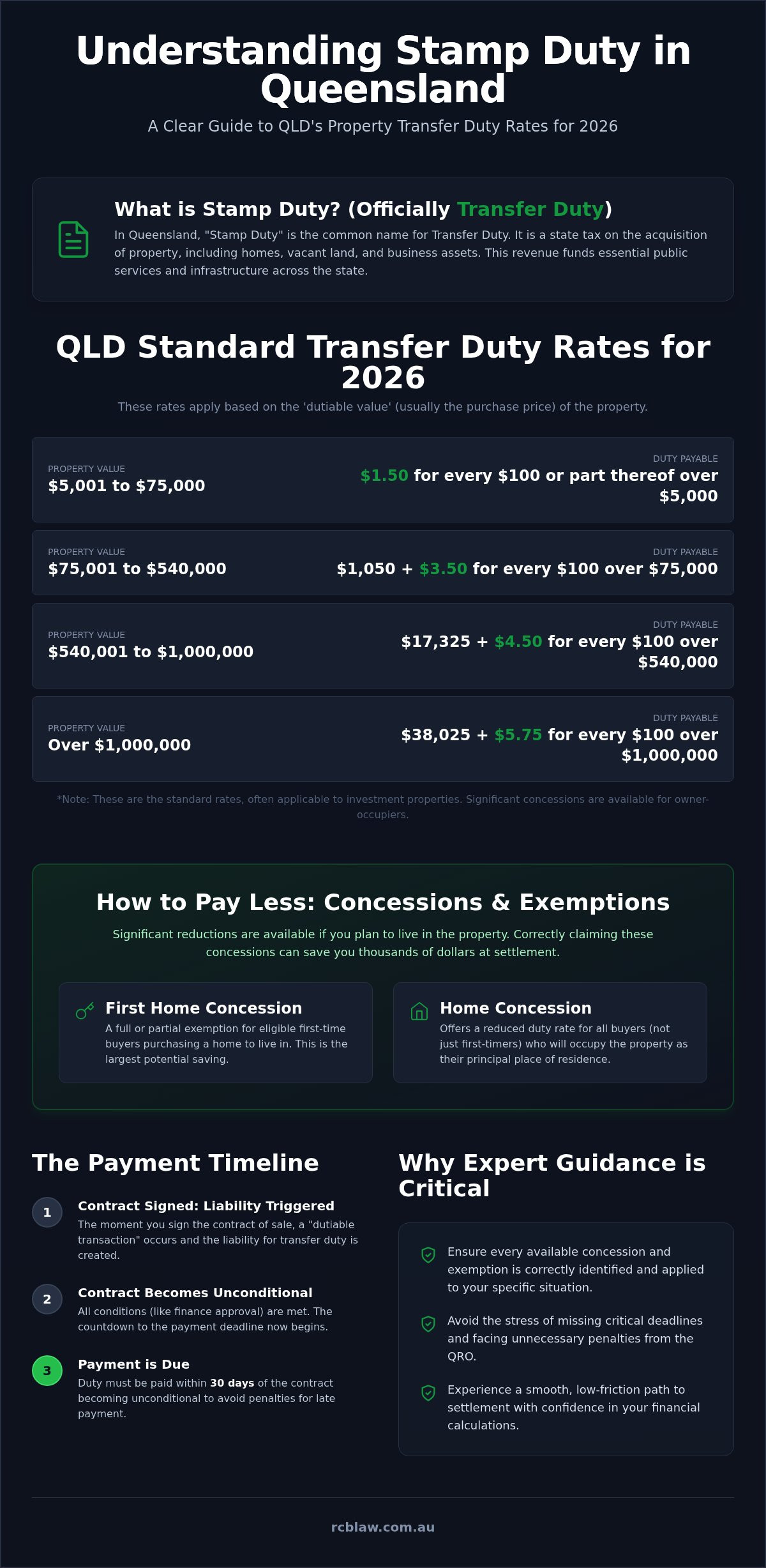
The calculation follows a specific set of tiers based on the property's value. The math involves a base amount for each tier plus a rate for every $100 of value over the threshold. It's helpful to know that the QRO rounds up. If your property value includes a fraction of $100, such as $600,050, you'll pay the rate for that entire $100 block. The standard 2026 rates for investment or commercial properties are as follows:
- $0 to $5,000: Nil
- $5,001 to $75,000: $1.50 for every $100 or part of $100 over $5,000
- $75,001 to $540,000: $1,050 plus $3.50 for every $100 or part of $100 over $75,000
- $540,001 to $1,000,000: $17,325 plus $4.50 for every $100 or part of $100 over $540,000
- Over $1,000,000: $38,025 plus $5.75 for every $100 or part of $100 over $1,000,000
Investment vs. Owner-Occupier Math
The purpose of your purchase significantly impacts the final bill. Investors typically pay the standard rates mentioned above. If you're purchasing for business purposes, commercial conveyancing involves specific duty considerations that our team can help you navigate with ease. Contrast this with an owner-occupier who intends to live in the home. For a $750,000 property in Brisbane, an investor would pay $26,775 in duty. Someone buying the same house to live in as their principal residence would pay $19,600. That's a difference of $7,175 just based on your intent for the property. Understanding these nuances helps you avoid overpaying and ensures your settlement funds are exactly where they need to be. If you're feeling uncertain about your specific figures, our expert team at RCB Law can provide a fixed-price quote to clarify your obligations.
Concessions and Exemptions: How to Pay Less
While calculating how much is stamp duty in qld can initially feel like a heavy financial burden, the good news is that many buyers qualify for significant discounts. These concessions are designed to make property ownership more accessible, particularly for those buying a home to live in rather than as an investment. We find that many clients feel a great sense of relief once they realize they don't have to pay the full standard rate. By understanding which exemptions apply to your situation, you can protect your savings and move toward settlement with greater confidence.
For 2026, the Queensland government has maintained generous thresholds for first-time buyers. If you are purchasing an established home as your first property, you may receive a full exemption on properties valued up to $700,000. For homes priced between $700,001 and $800,000, a partial concession still applies, significantly reducing the total duty. If you're building a new home, the First Home Vacant Land Concession offers similar relief, ensuring that those starting from scratch aren't unfairly penalized by the tax system.
Qualifying for the First Home Concession
To access these savings, you must meet specific eligibility criteria. First, you must be an individual at least 18 years of age. The most critical rule is that you've never owned residential property anywhere in the world before. This isn't limited to Australia; the QRO looks at your global property history. Additionally, you must move into the property and live there as your principal place of residence within one year of the settlement date. You also cannot dispose of the property, such as by selling or leasing it, within that first year if you want to retain the full benefit of the concession.
The Home Concession (Principal Place of Residence)
Even if you've owned property before, you may still be eligible for the Home Concession. This is separate from the First Home Buyers Grant QLD, which is a direct payment for new builds. The Home Concession works by applying a lower tax rate to the first $350,000 of the property's value. This concession is available to any buyer who intends to live in the home as their primary residence. It's a vital tool for families upgrading or individuals relocating, as it ensures that "owner-occupiers" pay less than investors. Beyond these common concessions, exemptions also exist for specific life events, such as the transfer of property between spouses or following the death of a property owner, which helps ease the emotional and financial transition during difficult times.
The Settlement Process: Payment Timelines and AFAD
Once you've determined how much is stamp duty in qld for your specific purchase, the next step is understanding the mechanics of payment. In Queensland, the deadline for paying transfer duty is strictly enforced. Generally, you must lodge your documents and pay the duty within 30 days of the contract becoming "unconditional." This is a critical distinction because it often occurs before the actual settlement date. We understand that managing these dates can feel high-pressure, which is why our team handles the lodgement process on your behalf, ensuring every deadline is met with precision.
Modern property transactions in Queensland are managed through the PEXA platform, an electronic settlement system that provides a secure and transparent way to transfer funds. Your solicitor uses PEXA to coordinate with your bank and the Queensland Revenue Office. This digital approach removes much of the traditional friction associated with paper documents and manual cheques. By automating the payment at settlement, we provide you with the confidence that your legal obligations are fulfilled without last-minute hurdles.
Managing the Payment Timeline
While the law allows 30 days from the unconditional date, most residential buyers find it easiest to have the duty paid on the day of settlement. If you're borrowing to fund the purchase, your bank will typically treat the duty as a required deduction from your loan draw-down. They want to ensure the title can be registered in your name immediately, which requires the duty to be cleared first. If payment is delayed beyond the 30-day window, the government applies Unpaid Tax Interest (UTI). This interest accrues daily, so accuracy and punctuality are vital to avoid unnecessary costs that can inflate your initial budget.
Additional Foreign Acquirer Duty (AFAD)
For foreign investors, the calculation of how much is stamp duty in qld includes an additional layer known as AFAD. A "foreign person" can include individuals who are not Australian citizens or permanent residents, as well as certain foreign corporations or trusts. For 2026, the AFAD rate remains at 8% of the property's value. This is a surcharge that applies on top of the standard transfer duty rates discussed earlier.
This surcharge has a noticeable impact on the high-end property markets in Brisbane and the Sunshine Coast, where foreign interest remains steady. For example, a foreign buyer purchasing an $800,000 residential property would pay the standard duty plus an additional $64,000 in AFAD. Because these figures are substantial, it's essential to have your residency status reviewed early in the process. If you want to ensure your settlement proceeds without any hidden financial surprises, get in touch with RCB Law for a detailed assessment of your transaction.
Why Expert Conveyancing is Your Best Defense Against Overpaying
Understanding how much is stamp duty in qld is the first step, but ensuring you actually pay the correct amount requires a specialized eye. While the math might seem straightforward on paper, the application of transfer duty involves a complex interaction of state legislation and individual circumstances. At RCB Law, we bring over 30 years of industry experience to every transaction. Our role is to act as your steady guide, removing the friction from what can often be a high-pressure transition. We don't just process paperwork; we actively look for every legal avenue to reduce your duty liability, ensuring you don't pay a cent more than the law requires.
Our local focus on the Sunshine Coast and Brisbane communities allows us to navigate Queensland Revenue Office (QRO) requirements with a high level of mastery. We handle all the necessary lodgements and digital filings on your behalf, so you don't have to worry about missing a deadline or making a technical error. This proactive communication is designed to build trust and provide you with a sense of security as we determine how much is stamp duty in qld for your specific settlement. We believe that professional support should feel like a partnership that alleviates your emotional burden.
Avoiding Costly Lodgement Errors
Many buyers attempt to self-calculate their duty using online tools, but these often miss the nuances of specific concessions. A common error involves failing to account for the exact occupancy requirements or misinterpreting the "part of $100" rule. Beyond the immediate payment, we also ensure your property title aligns with your broader estate planning, including your will. This holistic approach prevents future tax complications and ensures your assets are protected for the long term. In a high-cost market, our fixed-price conveyancing options provide the financial certainty you need to plan your move with confidence.
The RCB Law Difference
We believe that property law should be a supportive partnership rather than a cold, transactional process. Our team is dedicated to providing clear, direct assistance that validates your concerns and soothes the anxieties of moving. Before you commit to a purchase, we strongly recommend a contract review. This simple step ensures that your eligibility for concessions is protected from the outset. Whether you are settling in the heart of Brisbane or along the Sunshine Coast, our local expertise is your greatest asset. Reach out to us today for a tailored quote and experience a low-friction path to your new home.
Secure Your Property Future with Confidence
Securing a new home should be a time of excitement, not a period of financial stress. We have explored the essential rates and timelines that determine how much is stamp duty in qld, helping you prepare for settlement with total clarity. By identifying every available concession and ensuring your lodgements are accurate, you can protect your savings and avoid the anxiety of government penalties. Our goal is to provide the steady guidance you need to move through this transition with ease.
With over 30 years of Queensland property law expertise, our team serves as your local specialists across Brisbane and the Sunshine Coast. We provide fixed-price residential conveyancing to give you certainty in a high-pressure market. Let RCB Law handle your QLD settlement with confidence—Contact our conveyancing experts today. We look forward to helping you step into your next chapter with peace of mind and professional support you can depend on.
Frequently Asked Questions
How much is the first home buyer stamp duty concession in QLD for 2026?
For 2026, first-home buyers of established homes receive a full exemption on properties valued up to $700,000. A partial concession is available for homes priced between $700,001 and $800,000. If you are purchasing a new home or vacant land to build on, a full exemption applies with no value cap as of May 2025. These incentives are designed to help you step onto the property ladder with a lighter financial burden.
Do I have to pay stamp duty on a property I inherited in Queensland?
Generally, you won't pay transfer duty on a property inherited through a valid will or under the laws of intestacy. The Queensland Revenue Office provides this exemption to prevent additional financial stress during a period of personal loss. However, if the beneficiaries choose to redistribute the estate's assets in a way that differs from the will, duty may apply. We recommend a legal review to ensure the transfer remains low-friction.
Can I add the cost of stamp duty to my home loan?
Many lenders allow you to use your loan funds to cover the duty, provided your total borrowing remains within their loan-to-value ratio limits. This is a practical way to manage the question of how much is stamp duty in qld without needing the entire amount in cash. Your bank will typically ensure these funds are available at settlement to clear your government obligations before the property title is registered.
How long do I have to live in a house to get the QLD home concession?
To retain the home concession, you must move into the property within one year of settlement and occupy it as your principal place of residence for at least one continuous year. If you sell or lease the property before this 12-month period ends, you may be required to pay a reassessment of the duty. This requirement ensures the concession supports genuine owner-occupiers rather than those seeking short-term investment gains.
Is stamp duty different for vacant land compared to an existing house?
The thresholds and concessions for vacant land are distinct from those for existing homes. While an established house qualifies for the standard home concession, vacant land has its own First Home Vacant Land Concession for those building their first residence. The rates and exemptions are calculated based on the land's value alone. Navigating these categories correctly ensures you don't miss out on savings specifically tailored for new constructions.
What happens if I don’t pay my transfer duty on time?
Failing to pay within the 30-day window after a contract becomes unconditional triggers Unpaid Tax Interest (UTI). This interest is calculated daily and can quickly add up. The Queensland Revenue Office may also apply additional penalties for late lodgement. Our team prioritizes these timelines to protect you from these avoidable costs. We handle the lodgement process on your behalf to ensure your settlement journey remains smooth and secure.
Are there stamp duty exemptions for transfers between spouses in QLD?
Exemptions are often available for property transfers between spouses or de facto partners, especially when the property is the principal place of residence. These rules allow couples to restructure their ownership or gift interests in a home without the burden of a standard tax bill. Certain criteria regarding the relationship and the property's use must be met. We provide the clarity needed to ensure these transfers are handled with professional care.
Does the QLD stamp duty rate change for commercial properties?
Commercial properties are typically subject to the standard transfer duty rates and don't qualify for the home concessions reserved for residential owner-occupiers. The duty is calculated on a sliding scale based on the property's market value or purchase price. For investors in Brisbane and the Sunshine Coast, accurately budgeting for these standard rates is essential. Our commercial property experts help you identify the exact costs involved to ensure your business investment is sound.


