
The moment you sign a business contract should be a celebration of your future, not the start of a sleepless night wondering if you've inherited someone else's tax debt. You've likely spent months searching for the right opportunity, yet the closer you get to the finish line, the more the complexity of the "fine print" can feel overwhelming. It's completely natural to feel anxious about hidden liabilities or the specific nuances of the REIQ Business Sale Contract. Understanding the legal steps to buying a business in Queensland is the most effective way to turn that uncertainty into a confident, secure transition.
We believe that acquiring a new venture shouldn't be a high-pressure ordeal. This guide provides a clear, structured path to help you manage the legal requirements of your purchase with minimal friction. We'll explore the critical stages of due diligence, the realities of lease assignments, and how to correctly handle employee entitlements under the Fair Work Act. By the end of this article, you'll have a practical roadmap for a smooth transfer of ownership; this ensures your new business's value is protected from the very first day.
Key Takeaways
- Learn why the REIQ Business Sale Contract is the industry standard for Queensland acquisitions and how to navigate its essential components, including goodwill and equipment valuations.
- Follow a structured guide to the legal steps to buying a business in queensland to avoid hidden liabilities and move toward ownership with confidence.
- Identify the vital role of legal due diligence in uncovering risks that financial audits might miss, ensuring the business's foundation is truly solid.
- Simplify the transition of premises and staff by understanding the specific requirements of the Retail Shop Leases Act and the Fair Work Act.
- Prepare for a successful settlement day by learning how professional legal guidance manages final price adjustments and the formal transfer of ownership.
Understanding the Legal Landscape of QLD Business Acquisitions
Stepping into business ownership is a significant personal and professional milestone. It represents a major shift in your daily life and your financial future. Because this is more than just a transaction, you need a process that respects the weight of the decision. Navigating the legal steps to buying a business in Queensland requires a structured approach to risk management, ensuring that the excitement of a new venture isn't overshadowed by legal uncertainty.
Queensland operates under a specific set of legal frameworks that differ from other Australian states. The REIQ Business Sale Contract is the industry standard here, providing a familiar starting point for most transactions. However, even standard contracts require a steady hand to tailor them to your specific needs. A local solicitor is essential for navigating state-specific requirements, such as stamp duty assessments and regional regulations. Our role is to remove friction from the process, providing the clarity you need to move forward with confidence.
The Key Legal Players in Your Purchase
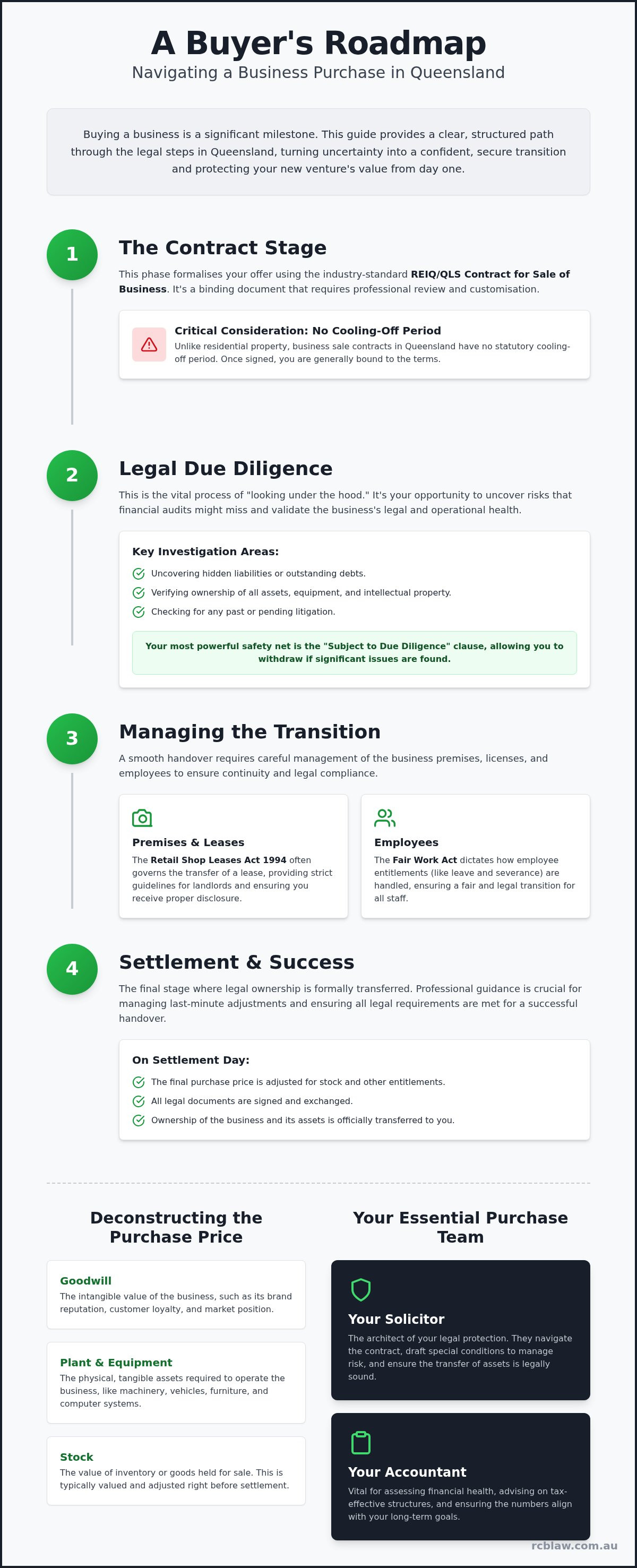
A successful purchase relies on a collaborative team of experts who each play a distinct role in protecting your interests. Your solicitor acts as the architect of your legal protection. They navigate the contract, draft special conditions, and ensure that the transfer of assets is legally sound. Your accountant is equally vital, focusing on tax structures and financial health to ensure the numbers align with your goals.
This team works together during Legal Due Diligence, which is the vital process of "looking under the hood" to verify the business's legal standing. We look for hidden liabilities, verify ownership of assets, and check for any history of litigation. On the other side of the table, the seller's legal representative and the business broker facilitate the flow of information, but your team remains your primary shield against unforeseen risks.
Why Queensland Law is Unique for Business Buyers
Queensland's legal environment includes specific protections that every buyer should understand. If your business operates from a physical storefront, the Retail Shop Leases Act 1994 often applies. This Act provides strict guidelines for landlords and tenants, ensuring you receive proper disclosure before you're bound to a lease. The Queensland Law Society plays a central role in standardising business contracts to maintain high professional standards across the state.
Local knowledge is particularly important in the Sunshine Coast and Brisbane markets. These regions have their own commercial rhythms and property customs that can influence a sale. Understanding these regional nuances is one of the most critical legal steps to buying a business in Queensland. It ensures your purchase isn't just legally compliant, but also strategically sound for the local market you're entering.
The Contract Stage: Navigating the REIQ Business Sale Agreement
Once you've found a business that aligns with your goals, the next phase involves formalising your offer. In Queensland, the standard document used is the REIQ/QLS Contract for Sale of Business. This contract is designed to balance the interests of both parties, but it's far from a "one size fits all" solution. It requires careful customisation to reflect the specific assets and obligations you're taking on. One of the most critical legal steps to buying a business in Queensland is ensuring this document is reviewed by a professional before you commit your signature. Unlike residential property, there is no statutory cooling-off period for business sales; once you sign, you're generally bound to the terms.
The contract breaks down the total purchase price into three main categories: plant and equipment, stock, and goodwill. Goodwill represents the intangible value of the business, such as its reputation and customer base. Correctly allocating these values is essential for both tax purposes and future depreciation claims. To ensure you're making an informed decision, your solicitor will include a "Subject to Due Diligence" clause. This is your most powerful safety net. It allows you to withdraw from the contract if your investigations reveal issues that weren't apparent at first glance. For more information on the broader process, you can refer to this Queensland Government guide.
Essential Special Conditions to Consider
Standard contracts often lack the specific protections needed for unique business models. We frequently recommend adding special conditions that act as "escape hatches" or protective barriers. A "subject to finance" clause protects your deposit if your lender doesn't approve the loan. Similarly, a "subject to lease assignment" condition ensures you aren't stuck buying a business without a physical location to operate from. Finally, a restraint of trade clause is vital. It prevents the seller from opening a competing business within a certain distance or timeframe, protecting the goodwill you've just paid for.
The Importance of a Detailed Asset Schedule
The asset schedule is a comprehensive list of every physical item included in the sale. It's not enough to list "kitchen equipment"; you need makes, models, and serial numbers. We use this list to perform searches on the Personal Property Securities Register (PPSR) to ensure no bank or third party has a "charge" or lien over the equipment. If the seller hasn't paid off their equipment finance, those debts could follow the assets to you. We also verify the transfer of intellectual property, including trademarks and business names, so you own the brand you're building. If you're feeling uncertain about these technicalities, our team at RCB Law can help clarify your obligations.
Legal Due Diligence: Uncovering Risks and Validating Value
Legal due diligence is the process of peeling back the layers of a business to ensure what you're buying is exactly what's been described. While your accountant focuses on the profit and loss statements, our role is to examine the legal foundation. This is one of the most critical legal steps to buying a business in Queensland because it prevents you from inheriting past mistakes or legal liabilities. We look for the "red flags" that might not appear on a balance sheet, such as pending litigation, undisclosed debts, or expired permits.
A structured investigation typically follows a five-step path to ensure nothing is missed. First, we verify the legal entity through ASIC to confirm the seller has the right to sell. Second, we check asset ownership via the PPSR. Third, we audit regulatory compliance. Fourth, we review material contracts with suppliers and customers. Finally, we investigate the business's litigation history. For larger transactions, we also consider ACCC merger regulations to ensure the acquisition doesn't breach federal competition laws. This methodical approach turns a high-pressure situation into a manageable, transparent process.
Verifying Licenses and Permits
In Queensland, many businesses rely on specific permits to operate legally. Whether it's a food business license from a local Sunshine Coast or Brisbane council or a specialized industry permit, these must be current and transferable. We work with you to ensure all Queensland Health requirements are met before settlement. If a license transfer fails or is overlooked, you could find yourself legally unable to trade on your first day of ownership, which can be a devastating start to your new venture.
Reviewing Material Contracts
The value of many businesses lies in their relationships with suppliers and customers. We analyze these material contracts to ensure they'll continue under your new ownership. It's vital to check for "change of control" clauses; these are terms that allow a supplier to terminate an agreement simply because the business has changed hands. We also evaluate customer service level agreements to ensure the obligations you're inheriting are realistic and profitable. By validating these agreements, we help protect the goodwill you're paying for and ensure the business remains viable from day one.
Managing the Transition: Leases, Licenses, and Employees
Successfully navigating the legal steps to buying a business in Queensland requires more than just a signed contract. It involves managing what we call the "Holy Trinity" of transitions: Premises, People, and Paperwork. This stage is often where buyers feel the most pressure, as it requires coordination between landlords, staff members, and government bodies. Our goal is to provide a steady hand through these moving parts, ensuring you step into a business that is ready to operate from day one without lingering liabilities.
In Queensland, the Retail Shop Leases Act 1994 provides a robust framework that both protects and binds you as a tenant. Understanding how this legislation interacts with your specific lease is vital. Whether you're taking over a boutique in Brisbane or a cafe on the Sunshine Coast, the transition of your physical location must be handled with precision to avoid future disputes with your landlord.
The Lease Assignment Process in QLD
Assigning a commercial lease is a formal process where the landlord must give their consent for the seller to transfer their obligations to you. While a landlord cannot unreasonably withhold consent, they have the right to verify your financial standing and business experience. A critical legal protection in this process is the Disclosure Statement. Under Queensland law, both the landlord and the seller must provide you with these statements at least seven days before you enter into the lease. These documents reveal essential details about outgoings, redevelopment clauses, and other hidden costs. For a deeper look at this area, you may find our article on Commercial Conveyancing: A Complete Guide for QLD Businesses helpful.
Employee Entitlements and Transfer of Business
When a business changes hands, the treatment of staff is governed by the Fair Work Act. As of May 2026, the law remains clear that when a business transfer occurs, employees' service with the previous employer is generally recognised for entitlements like personal leave and parental leave. However, the new employer has specific choices regarding redundancy and annual leave recognition. This is why the "adjustment" at settlement is so important. We ensure that the purchase price is adjusted to account for the leave balances you're inheriting. This prevents you from paying out thousands of dollars in leave that was actually accrued while the staff worked for the seller. If you're concerned about how these calculations might impact your initial cash flow, our team at RCB Law can review your staff list and provide clear guidance on your obligations.
From Settlement to Success: Finalising Your Purchase with RCB Law
Settlement day is the culmination of your hard work and planning. While the lead-up involves intense scrutiny and negotiation, the day itself should feel like a smooth transition into your new role as a business owner. Our team manages the technical heavy lifting, allowing you to focus on the operational handover. This stage is one of the most rewarding legal steps to buying a business in Queensland, as it marks the official transfer of goodwill, equipment, and future potential into your hands.
With over 30 years of experience across Brisbane and the Sunshine Coast, we've refined a low-friction settlement process. We perform final PPSR checks on the morning of settlement to ensure no new encumbrances have been lodged against the assets. We also coordinate the exchange of physical keys and digital assets, such as social media accounts and domain passwords, ensuring you have full control from the moment the final payment is cleared. Our goal is to ensure that when you walk through the door as the owner, every legal detail has been resolved.
The Settlement Adjustment Sheet Explained
The settlement adjustment sheet is the final financial blueprint of the transaction. It ensures that neither the buyer nor the seller is unfairly burdened by costs that bridge the ownership period. We calculate pro-rata adjustments for commercial rent, local council rates, and water charges. Crucially, we also adjust for employee leave entitlements and the final stock-on-hand value determined during the pre-settlement stocktake. The final adjustment sheet requires absolute mathematical precision to ensure every cent of the purchase price is correctly allocated and accounted for.
Post-Settlement: Your Legal To-Do List
Your legal obligations don't entirely end when the keys change hands. Once ownership is transferred, we assist in the formal registration of business names and trademarks with ASIC and IP Australia. This secures your brand identity for the long term and prevents others from infringing on your new intellectual property. Additionally, acquiring a business is a major change in your financial circumstances that necessitates a review of your personal legal affairs. It's essential to update your Will to include your new business assets, ensuring your legacy is protected. You can read more about this in our guide on Why You Need a Will: A Comprehensive Guide for Queenslanders.
Ready to Embark on Your Next Business Venture?
Purchasing a business is a transformative life event that requires a methodical approach. By following the structured legal steps to buying a business in Queensland, you ensure that your investment is protected from hidden liabilities and that the transition of employees and leases is handled with absolute clarity. From the initial contract review to the final settlement adjustment, every phase is an opportunity to build a secure foundation for your future success. You shouldn't have to navigate these complexities alone; having a steady guide makes all the difference.
With over 30 years of experience as local specialists in the Sunshine Coast and Brisbane regions, we understand the nuances of the Queensland market. We offer fixed-price conveyancing options to provide you with financial certainty throughout the process. Our team is here to act as your supportive partner, removing the friction and anxiety often associated with complex commercial acquisitions. We're dedicated to ensuring your transition is as smooth and secure as possible.
Secure your business future with RCB Law’s expert guidance
We look forward to helping you turn your vision of ownership into a successful, stress-free reality. Your new chapter starts with the confidence that every legal detail is in expert hands.
Frequently Asked Questions
Do I need a lawyer to buy a business in Queensland?
You should engage a solicitor to ensure your interests are protected throughout the acquisition. Buying a business involves complex legal obligations, such as transferring leases and verifying asset ownership. A solicitor reviews the REIQ contract, identifies potential risks, and manages the settlement process. This expert guidance is one of the most important legal steps to buying a business in Queensland, as it prevents you from inheriting the seller's undisclosed debts or legal disputes.
How long does the legal process of buying a business usually take in QLD?
The process typically takes between four and eight weeks from the time an offer is accepted to the final settlement. This timeframe allows for essential stages like financial and legal due diligence, which usually requires 14 to 21 days. Additionally, obtaining landlord consent for a lease assignment can take several weeks. We work to keep the timeline moving efficiently, ensuring all conditions are met without unnecessary delays or friction for either party.
What is the subject to due diligence clause in a QLD business contract?
This clause is a vital protective condition that allows you to investigate the business's records before the sale becomes unconditional. It gives you a specific period, often 14 days, to verify financial records, legal compliance, and operational viability. If you aren't satisfied with the results of your investigation, you can terminate the contract without penalty. It's a critical safeguard that ensures you only proceed when you're fully confident in the business's value.
What happens to the employees when I buy an existing business?
Under the Fair Work Act, employees' service with the previous owner is generally recognised for entitlements like personal leave and parental leave. As the new owner, you may choose whether to recognise service for redundancy or annual leave, though specific conditions apply. We ensure the purchase price is adjusted at settlement to account for these accrued balances. This prevents you from being financially responsible for entitlements that staff earned while working for the previous employer.
Do I have to pay stamp duty when buying a business in Queensland?
Yes, transfer duty applies to the dutiable value of business assets in Queensland. As of June 2026, rates vary based on the purchase price. For assets valued between $75,001 and $540,000, the duty is $1,050 plus $3.50 for every $100 over $75,000. For transactions over $1,000,000, the rate is $38,025 plus $5.75 for every $100 over the million mark. We help you calculate these costs accurately to avoid surprises during your acquisition.
What is a Disclosure Statement in a QLD retail lease?
A Disclosure Statement is a mandatory document under the Retail Shop Leases Act 1994 that outlines the key financial and legal terms of a lease. It includes details about rent, outgoings, and any specific redevelopment clauses that might affect your tenancy. Both the landlord and the seller must provide these statements to you at least seven days before you enter the lease. Reviewing these documents is one of the essential legal steps to buying a business in Queensland.
Can a landlord refuse to assign a lease to me when I buy a business?
A landlord cannot unreasonably withhold consent to a lease assignment, but they have the right to ensure you're a suitable tenant. They will typically review your financial history, business experience, and personal references. If they believe you lack the resources or skills to manage the business successfully, they may have grounds to refuse. We assist you in preparing a professional "tenant pack" to demonstrate your suitability and make the approval process as smooth as possible.
Is there a cooling-off period for business purchases in QLD?
Unlike residential property transactions, there is no statutory cooling-off period for business purchases in Queensland. Once both parties sign the contract, it's legally binding according to its terms. This is why it's so important to have your solicitor review the agreement before you sign. We ensure that protective clauses, such as those for due diligence and finance, are included to give you the necessary "out" if the business doesn't meet your expectations.


